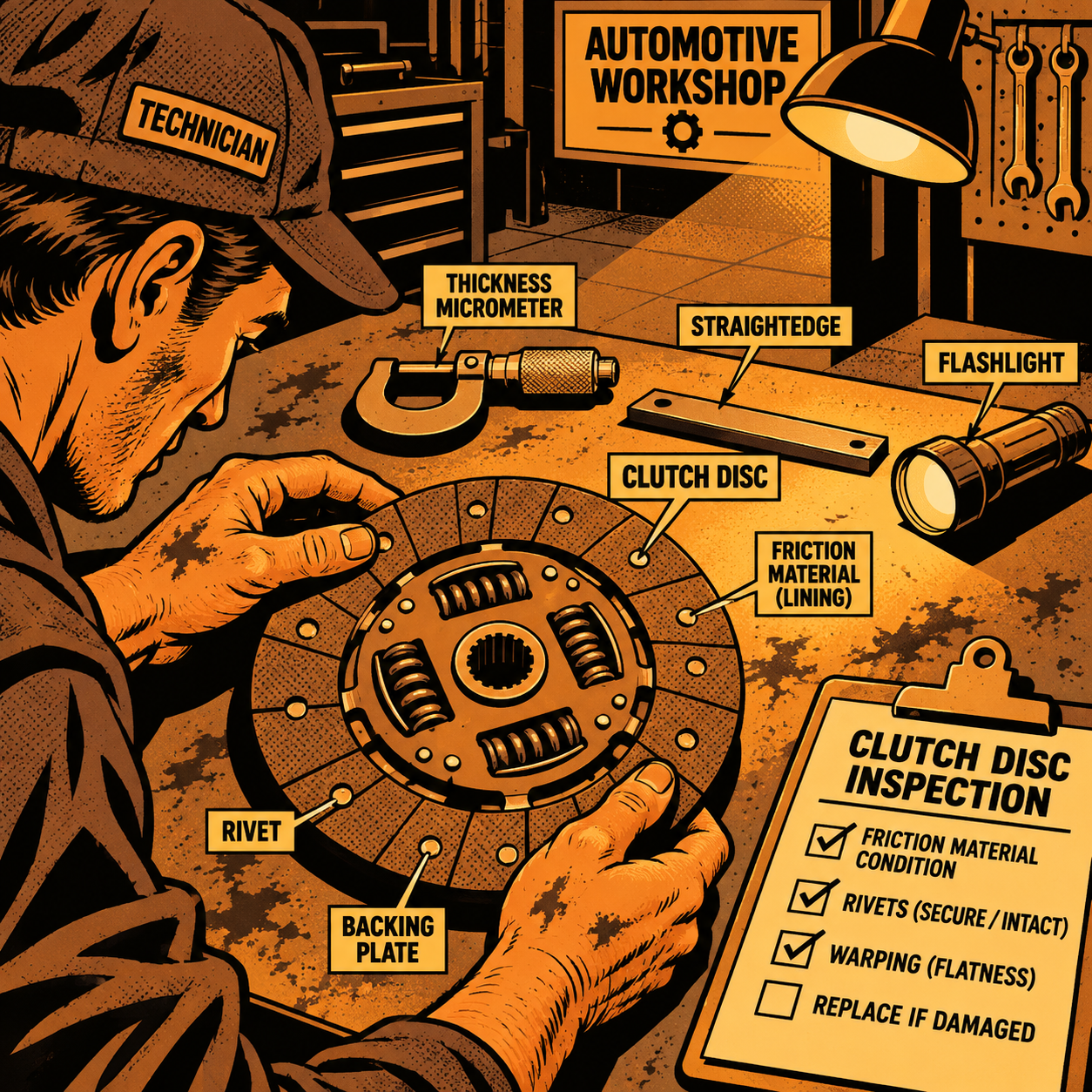
Opening a new clutch kit to find a chunk missing from the friction material is more common than most DIYers expect, and it sends a lot of people straight to the return counter. But technicians who’ve handled hundreds of these jobs know that cosmetic damage and functional damage are two different things. Before you box up a part or bolt in something that could fail at 20,000 miles, it helps to know exactly what to inspect, what the manufacturer specs actually allow, and where “it’ll be fine” stops being good advice.
Inspecting a New Clutch Disc Before Install
A small chip in the friction material at the outer edge of a clutch disc is rarely a functional problem. The lining is designed to wear down over the life of the part, and a minor edge chip doesn’t change how the disc clamps or transmits torque in any meaningful way. The failure points to actually check are different:
- Is the disc warped or bent? Lay it on a flat surface and check for rock or wobble. A bent disc will cause chatter, incomplete engagement, or uneven wear from day one.
- Are any rivets loose, exposed, or missing? Rivets hold the friction material to the disc plate. If a rivet head is exposed or the material around it has crumbled away, that’s a structural issue, not a cosmetic one.
- Is the missing material a small edge chip, or a sizable section that exposes bare rivets or backing plate? A nick the size of a fingernail is cosmetic. A chunk that takes out a meaningful percentage of the contact surface changes clamping behavior and should not be installed.
Rule of thumb: unless a large section is gone or a rivet has come loose, the disc will almost certainly perform normally. If you’re on the fence, photograph it next to a coin for scale before deciding — that photo is also useful if you end up calling the parts supplier.
Flywheel Resurfacing: Know the Spec Before You Cut
Resurfacing (also called “turning” or “skimming”) a flywheel removes a thin layer of material to create a flat, true surface for the new disc to grip. This is routine on a lot of vehicles, but it is not universal, and getting it wrong causes real problems.
- There’s a minimum thickness spec. Every flywheel has a factory thickness tolerance. Cutting below that spec changes the clamping geometry of the pressure plate — on non-adjustable clutch setups, this effectively recreates the same “worn clutch” symptoms you’d get from a thin disc: reduced clamp force, slippage, and premature failure, even though every part is technically new.
- Some manufacturers explicitly prohibit resurfacing. Certain flywheels are manufactured to a tolerance where any material removal risks overheating or glazing the surface, which kills clutch engagement quality. Check the service manual or manufacturer TSBs for your specific vehicle before assuming resurfacing is always an option.
- If the flywheel is pitted, cracked, or heat-scored beyond the allowable cut depth, replace it. Don’t try to machine out damage that exceeds the spec just to save the cost of a new flywheel — the clutch disc’s contact pattern depends on that surface being within tolerance.
When in doubt, measure the flywheel’s current thickness against the service manual’s minimum before sending it to a machine shop, and tell the shop the exact figure. Don’t let a shop “just skim it a little” without confirming you’re still within spec afterward.
Shop for flywheel resurfacing gauges, thickness micrometers, and flywheel alignment tools:
SEARCH_PRODUCTS: flywheel thickness gauge and resurfacing tools


Hydraulic Grip-O-Matic Puller - 30-Ton 2-Jaw - 19-7/16 x 26 In
Mfg: OTC Tools and Equipment
Part #: 1073

Industrial Black Single Head Open End Wrench - 1-5/16" Opening
Mfg: Martin Tools
Part #: 8A
Dual-Mass Flywheels Change the Rules
Dual-mass flywheels (DMFs) — common on many modern diesels, turbocharged vehicles, and some performance platforms — use an internal spring-damper assembly between two flywheel halves to absorb drivetrain vibration. This design makes them fundamentally different from a solid single-mass flywheel in two ways that matter at the bench:
- They generally cannot be resurfaced. The friction surface thickness and the internal damper calibration are both part of the engineering tolerance. Removing material changes the geometry in ways a solid flywheel can tolerate but a DMF cannot.
- They have their own wear life independent of the clutch disc. A DMF can develop play, rattle, or rotational slop in the damper springs even when the friction surface looks fine. If you feel excessive rotational movement when you rock the flywheel by hand (with the clutch disc removed), that’s a wear indicator, not a defect — it typically means replacement, not resurfacing or reuse.
If you’re unsure whether a flywheel is dual-mass, check the parts catalog by VIN rather than going by eye — some DMFs look deceptively similar to solid flywheels from the engine side.
Hydraulic vs. Cable Clutch Linkages — Why “Fixed Position” Matters
A detail that trips up a lot of people doing their first clutch job: hydraulic clutch systems don’t have a manual adjustment point the way a cable clutch does. On a cable system — motorcycles are the easy example — there’s typically an adjuster at the lever, sometimes a barrel adjuster mid-cable, and another at the clutch cover, all there specifically to compensate for disc wear and keep the bite point consistent.
Hydraulic clutches don’t offer that same adjustability. The master and slave cylinders (or concentric slave cylinder on many modern setups) are sized to a fixed stroke, and the bite point simply moves as the disc wears over its service life — that’s normal and expected. The catch is this: if you change the flywheel’s thickness (by resurfacing past spec) or install a disc that’s not within factory thickness tolerance, you’ve effectively pre-aged the hydraulic system’s travel range. It may engage fine for a while, then slip or fail to fully engage sooner than a correctly speced clutch would. Some vehicles do have an adjustable pushrod between the clutch master cylinder and the pedal — check your service manual, since this varies by platform — but it’s not a substitute for correct flywheel and disc dimensions.
Doing the Job Right: Related Wear Parts
Since a clutch disc rarely fails alone, and the labor to get back to the clutch is the expensive part of this job, replace the full wear set in one pass:
- Pressure plate — clamping force degrades with heat cycles even if it looks visually fine.
- Throw-out (release) bearing — a common premature-failure point, especially if a cheaper bearing is substituted to save cost. Spending more here is generally worth it, since a repeat failure means repeating all the labor.
- Pilot bearing/bushing — small part, but it’s buried behind the flywheel and not worth skipping on a job that already requires removing the transmission or subframe.
On vehicles with a torque tube or similar driveline layout, you may need to drop the subframe or even pull the engine to access the gearbox — on some platforms it’s genuinely easier to pull the motor than to wrestle the transmission out around the torque tube. Plan the job around whichever access method actually requires less disassembly for your specific platform, not just the “standard” method.
Quick Pre-Install Checklist
- Disc friction material: no missing rivets, no large sections gone, lies flat with no warp
- Flywheel: confirmed thickness within manufacturer minimum spec before any resurfacing
- Flywheel type confirmed (solid vs. dual-mass) via VIN/parts lookup, not visual guess
- Pressure plate, throw-out bearing, and pilot bearing replaced as a set
- Hydraulic linkage bled and pushrod adjustment (if equipped) checked per service manual
- Access method planned (subframe drop, torque tube clearance, or engine-out) before starting teardown
Shop clutch kits, flywheels, and the release/pilot bearings needed to finish the job in one visit:
SEARCH_PRODUCTS: clutch kit flywheel throw-out bearing pilot bearing

Frequently Asked Questions
Is a small chip in a new clutch disc’s friction material a defect?
Usually not functionally. If it’s a minor edge chip with no exposed or loose rivets and the disc isn’t warped, it will typically perform normally for the life of the part. Large missing sections or exposed rivets are a different story and warrant a return.
Can I resurface any flywheel?
No. Resurfacing is allowed within a manufacturer-specified thickness tolerance on many solid flywheels, but some platforms prohibit it entirely, and dual-mass flywheels generally cannot be resurfaced at all. Check your service manual before sending it to a machine shop.
What happens if a flywheel is resurfaced below spec?
On a non-adjustable clutch setup, cutting below the minimum thickness changes the clamping geometry, which can mimic the symptoms of a worn clutch — reduced clamp force and premature slippage — even though the parts are new.
How do I know if my flywheel is dual-mass?
Look it up by VIN in the parts catalog rather than by eye; some dual-mass units look similar to solid flywheels. Rotational play when rocking the flywheel by hand (disc removed) is also a telltale wear sign specific to dual-mass designs.
Why doesn’t my hydraulic clutch have an adjuster like a cable clutch?
Hydraulic systems use a fixed-stroke master and slave cylinder, so the bite point naturally shifts as the disc wears rather than being manually adjustable. Some vehicles have an adjustable pushrod between the master cylinder and pedal, but that’s platform-specific — verify with the service manual.
Should I replace the throw-out and pilot bearings even if they look okay?
Yes. Both are hidden behind the flywheel/transmission and require the same labor to access as the clutch disc itself. Replacing them during the same job avoids paying for teardown labor twice if one fails prematurely.
Recommended Tools
Getting the job right requires accurate inspection and measurement. The Clutch Service Tools section covers flywheel gauges, alignment equipment, and removal aids.
- Flywheel thickness gauges and micrometers to verify resurfacing specs
- Flywheel resurfacing and alignment tools for precise machine work
- Clutch disc alignment and removal tools for safe installation

The Toolsource Technical Team blends decades of real-world automotive service experience with up-to-date technical research. Our writers collaborate with professional mechanics, shop owners, and diagnostic specialists to deliver practical, workshop-ready guidance you can trust.


Follow us on social media