
Testing a battery with a multimeter reveals voltage readings that indicate charge level and basic health. However, voltage alone doesn’t show whether a battery can actually deliver current under load—which is why understanding both readings and their limitations matters for accurate diagnosis.
Multimeter Setup for Battery Testing
Set your multimeter to DC voltage mode (marked “V⎓” or “DCV”). Never use AC voltage. Auto-ranging meters handle scale selection automatically; manual-range meters need the 20V setting for car batteries (12-14V) or 2V for household batteries (1.5V). Select the correct range to avoid damaging the meter.
Probe placement is critical: black probe goes to COM (common/ground), red probe to V (voltage). Never use the “A” (amperage) jacks for voltage testing—this creates a dangerous short. Press probe tips firmly to bare metal, cutting through any corrosion on terminals for accurate readings.

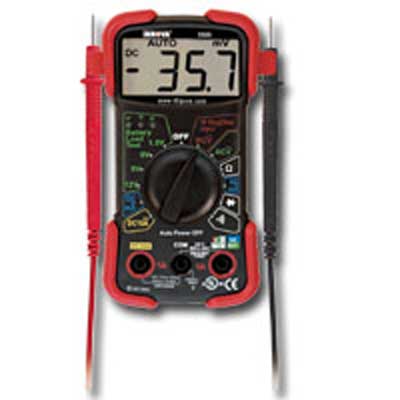
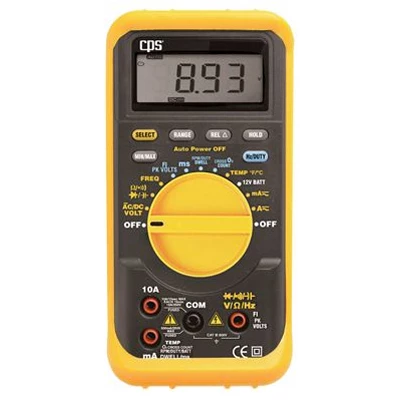
Current Probe and Digital Multimeter with Free Fuse Buddy Curren
Mfg: Electronic Specialties
Part #: 685P
Voltage Standards by Battery Type
Automotive batteries
A fully charged car battery reads 12.6-12.8V at rest (after sitting overnight). Interpret readings as: 12.6-12.8V = fully charged; 12.4-12.5V = 75% charged; 12.2-12.3V = 50% discharged; 12.0-12.1V = critically low; below 12.0V = deep discharge or failure. With the engine running, expect 13.5-14.5V (alternator charging). Readings below 13V mean alternator problems; above 15V indicate voltage regulator failure.
Household batteries
Alkaline batteries (AA, AAA, C, D) start at 1.5V and gradually lose voltage. Readings of 1.3-1.5V still work; below 1.2V are typically dead. Lithium batteries (CR2032, AA) read 3.0-3.3V (CR2032) or 1.5-1.7V (AA). Rechargeable NiMH cells read 1.2-1.4V when full; below 1.0V needs recharging. AGM batteries follow car battery standards but recover voltage faster after load.
What Voltage Readings Actually Show
Voltage indicates state of charge but not whether the battery can deliver current under load. Think of it like a gas gauge showing tank fullness without revealing if the pump works. A battery reading 12.6V might be unable to crank an engine because internal resistance (from sulfation, corrosion, or age) has increased, blocking current delivery even though voltage appears healthy.
Voltage testing successfully identifies:
- Charging system failures (battery below 12V when not charging)
- Surface charge conditions (falsely high readings after charging)
- Dead cells (automotive battery reading 10-11V)
- Parasitic drain (slow discharge over days)
Voltage testing fails to reveal:
- Cold cranking amperage (CCA) capacity—starting ability in winter
- Internal resistance from aging, even with stable voltage
- Capacity loss from sulfation or electrolyte degradation
- Performance under load—the actual use case that matters
Load Testing vs Static Voltage
Why multimeters alone are limited
Standard multimeters measure voltage under essentially zero load (less than 0.001 milliamps), so they don’t stress the battery. A battery can read perfect voltage while being unable to deliver the hundreds of amps needed for engine starting. Temperature also skews results—batteries read lower in cold weather and higher when warm, with capacity dropping about 50% at 0°F versus 80°F.
Professional load testing
Load testers apply calibrated resistance (typically half the battery’s CCA rating for 15 seconds) and measure voltage under this heavy load. A healthy battery maintains at least 9.6V under load; readings below 9.6V indicate excessive internal resistance and impending failure. This controlled test catches capacity loss that voltage-only testing misses.
When professional load testing is necessary:
- Intermittent no-start (battery reads 12.6V but sometimes won’t crank, especially in cold)
- Rapid voltage recovery (reads low then bounces back—surface charge masking reduced capacity)
- Batteries 5-7 years old should be tested annually
- After deep discharge below 12V
Many auto parts stores offer free testing with professional equipment. DIYers get the most value from combining a quick multimeter voltage check with free parts-store load testing.
| Method | Cost | Information | Best For |
|---|---|---|---|
| Multimeter Voltage | $20-80 | State of charge, charging system output, dead cells | Quick diagnosis, obvious problems |
| Professional Load Tester | $150-400 | CCA capacity, voltage under load, internal resistance | Final assessment, winter readiness, pro shops |
| Auto Parts Store Test | Free | CCA capacity, system voltage, starter draw, alternator output | DIY comprehensive testing |
| Battery Monitor | $100-300 | Continuous monitoring, discharge trends | Fleet vehicles, RVs, marine applications |
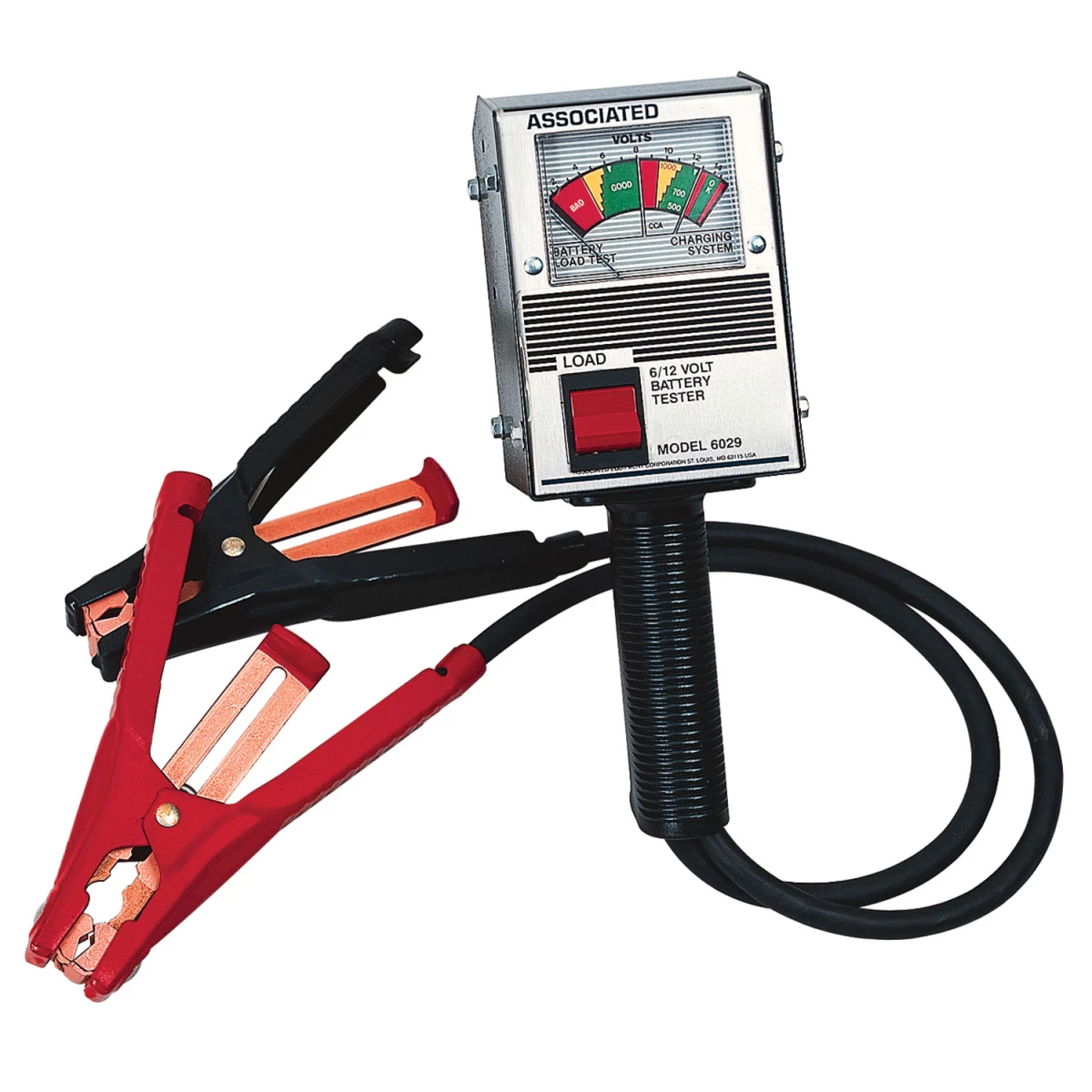
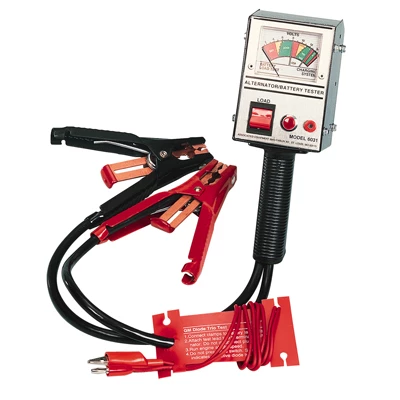
Alternator/Battery Load Tester - 0-16Volt 125AMP
Mfg: Associated Equipment
Part #: 6031



Common Testing Errors
Probe placement: Verify red probe is in “V” jack and black in “COM” before every test. Plugging into amperage jacks creates dangerous shorts.
Polarity confusion: Flipping probes shows negative voltage instead of positive—obvious on marked terminals but confusing on coin cells or unmarked batteries. The flat end of cylindrical batteries is negative; the button end is positive.
Wrong range on manual meters: Using 2V range on a 12V battery shows “OL” (overload). Use 20V for car batteries, 2V for household batteries, or switch to auto-ranging.
Surface charge masking problems: Fresh from charging, batteries read artificially high (13-14V). Run headlights 30 seconds before testing or wait several hours for accurate readings.
Shorted cells: A failing single cell might read 11.5-12.0V but perform terribly under load because it creates excessive internal resistance.
FAQ: Battery Testing with Multimeters
What voltage should a healthy car battery show?
12.5-12.7V at rest (after sitting several hours). Below 12.3V means significant discharge. With the engine running, 13.5-14.5V indicates proper charging. Below 13V with engine running signals charging problems; above 15V means overcharging.
Can a multimeter test capacity and cold cranking performance?
No. Multimeters show state of charge under zero load but cannot reveal current delivery capability. A degraded battery can read 12.6V while failing to crank because internal resistance blocks current flow. Professional load testing is necessary to measure actual capacity and predict winter performance.
Why does my battery read 12.6V but won’t start my car?
Voltage shows electrical pressure but not electrical flow. Your battery has adequate voltage potential but lacks internal conductivity to deliver sufficient current for the starter motor. Internal degradation (sulfation, corrosion, electrolyte stratification) increases resistance while barely affecting static voltage. Under cranking load, voltage collapses below the 9-10V minimum required for starting. Check for corroded cables, loose connections, or starter problems as well.
Should I test battery with the car running or off?
Test both. Engine off (after overnight sitting) shows state of charge and baseline health—expect 12.5-12.7V. Engine running shows charging system performance—expect 13.5-14.5V. Low voltage when off but normal when running means the battery is discharged but charging properly; check for parasitic drain or insufficient driving. Voltage staying below 13V when running indicates alternator or regulator failure.
Can I use a multimeter to test rechargeable power tool batteries?
Mostly not practical. Tool batteries have multiple stacked cells with protection circuits that block access to actual cell voltage. Nominal voltages differ from charged voltages—a “20V” battery reads 20-21V when full and 16-17V empty without manufacturer specs to interpret readings. Runtime and charge behavior tell you more than voltage. If the battery runs the tool adequately and charges normally, it’s fine.
What’s the difference between voltage testing and load testing?
Voltage testing checks electrical potential under no load, showing how charged the battery is but not how much current it can deliver. Multimeters draw less than 0.001 amps. Load testing applies significant resistance (typically half the battery’s CCA rating for 15 seconds) while measuring voltage. A healthy battery maintains 9.6V under load; weak batteries show excessive voltage drop from high internal resistance. Load testing simulates actual starting demands and predicts real-world performance voltage-only testing cannot.
For the tools in this guide, browse Battery Testers at Tool Source.

The Toolsource Technical Team blends decades of real-world automotive service experience with up-to-date technical research. Our writers collaborate with professional mechanics, shop owners, and diagnostic specialists to deliver practical, workshop-ready guidance you can trust.


Follow us on social media