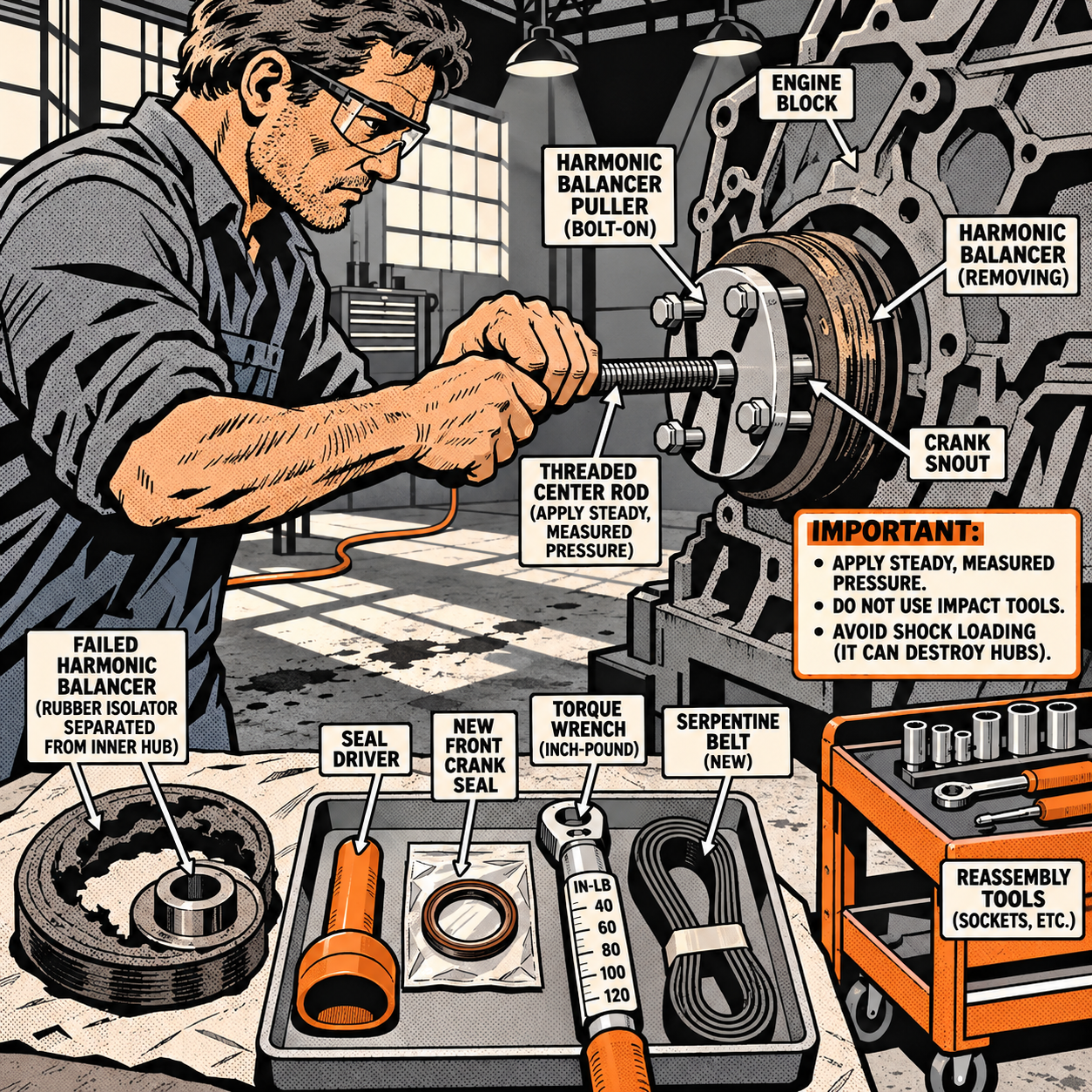
A harmonic balancer that visibly wobbles at idle isn’t a sound to shrug off — it’s a 5-10 pound mass spinning at 500 to 5,000+ RPM that’s no longer rotating true. When that happens, the failure doesn’t stay contained to the front of the engine. A departing pulley can shred the serpentine belt, punch through the radiator, slash wiring and hoses, and in the worst cases take the crankshaft snout with it. This guide walks through how to recognize the failure, what’s actually happening mechanically, and how to replace the part correctly instead of guessing.
Shut the Engine Off Immediately
If a customer’s vehicle rolls in with a visibly wobbling balancer or pulley, the first instruction is simple: kill the engine and don’t restart it until it’s inspected. Running it “just to get to the parts store” is the single most common mistake techs see with this failure. At operating RPM, an unbalanced rotating mass this size can shear its mounting bolts, separate entirely, and become a projectile inside the engine bay. Even if it doesn’t come off completely, the imbalance transmits straight into the crankshaft and main bearings, turning a $150-200 part replacement into a crank and bearing job.
Towing or a short, low-RPM limp to a bay is reasonable if the vehicle must be moved. Driving it under load, revving it, or ignoring the noise “because it still runs” is not.
Understand What’s Actually Failing
A harmonic balancer (also called a crank damper) is built from two main parts: an inner hub keyed or bolted to the crankshaft, and an outer ring bonded to it through a rubber isolator. That rubber absorbs torsional vibration from the crank’s firing pulses. When the rubber degrades — from age, heat, or oil contamination — the outer ring can separate from the hub and wobble independently while the hub itself stays put. Visually this looks like the whole pulley is loose, but the crank connection may be fine.
There’s a second, more serious failure mode: the bolts holding the pulley to the balancer hub (or the balancer to the crank snout) backing out or shearing. If that’s the cause, the wobble you see is the entire assembly working loose, not just the rubber isolator — and it’s far more likely to end with the pulley leaving the engine entirely or the crankshaft being damaged (wallowed keyway, bent snout) by the loose fasteners. On many V8 designs, those crank bolts use a reverse/left-hand thread specifically so normal engine rotation can’t back them out — if they’re loose anyway, something upstream already went wrong, and that needs explaining before you just torque things down and send the vehicle out.
You can’t tell which failure mode you’re dealing with by looking at it spin. It has to come apart to know for sure.


Diagnose Before You Order Parts
With the engine off and belt removed, grab the balancer by hand and check for independent movement between the outer ring and the hub — play here confirms a failed rubber isolator. Next, inspect the center bolt and any pulley-to-hub bolts for backing out, witness marks, or stripped threads. Pull the balancer (see below) and inspect the crank snout and keyway for elongation, scoring, or a bent taper. If the keyway is wallowed out or the snout shows damage, the balancer is the symptom, not the root cause, and the crankshaft itself needs evaluation before anything is reinstalled.
Also check the front main seal area and radiator/hoses for contact damage. A balancer that’s been wobbling for any length of time can nick a hose or crack a radiator core even before it fully fails — that damage won’t announce itself until it’s leaking.
Tools and Parts to Have on Hand
This is a straightforward job mechanically, but it’s not one to improvise without the right puller — pry bars and hammers on a balancer hub routinely destroy the hub, the crank snout, or both. Plan on:
- A dedicated harmonic balancer puller (bolt-on, not a slide hammer jammed behind the pulley)
- A balancer/crank pulley installer tool, or a long bolt and spacer setup rated for the press force on press-fit balancers
- New front crank seal — if you’re pulling the balancer anyway, replace the seal; it’s a few dollars and minutes compared to a second teardown
- Torque wrench capable of hitting the crank bolt spec, which is often well over 70-100 ft-lbs on V8 applications — this is not a job for guessing torque by feel
- New balancer bolt if the OEM spec calls for a one-time-use fastener (common on many modern applications)
- New serpentine belt, since the old one has likely been riding on a misaligned or wobbling pulley and may be glazed, nicked, or stretched
- Dial indicator, if available, to confirm runout on the new balancer once installed
Replacement Procedure
Disconnect the battery before starting — you’ll have the belt off and don’t want an accidental start while hands are near the crank. Remove the serpentine belt, then the center bolt (note the thread direction before applying force). Install the puller per its instructions, following even, incremental tension rather than cranking it hard in one shot — press-fit balancers can seize on the snout from corrosion and need steady pressure, not shock loading.
Once off, inspect the crank snout as described above. Clean the snout and seal bore, replace the front seal using a proper seal driver (not a socket that can cock it sideways), and lubricate the new seal’s lip and the snout per the seal manufacturer’s instructions. Align the new balancer’s keyway, press it on with the installer tool to the specified depth, and torque the retaining bolt to spec in the sequence the service manual calls for. Reinstall the belt, double-check pulley alignment across the accessory drive, and reconnect the battery.
Before road testing, bump the engine over by hand or with a remote starter switch with the belt off to confirm nothing binds, then run it briefly at idle and watch the new balancer for runout. A small amount of wobble immediately after installation that doesn’t match a known-good baseline is worth investigating before putting miles on it — it can point to a bent crank that survived the initial failure but is still out of true.
After the Repair: What Else to Check
A balancer failure rarely travels alone. Inspect the radiator, upper and lower hoses, and any wiring routed near the pulley for cuts, dents, or chafing caused by the wobble before it was caught. Check crank-driven accessories — water pump pulley, power steering pulley — for secondary wear from belt misalignment. If the vehicle was driven for any distance with a confirmed loose balancer, a compression or leak-down check isn’t unreasonable given the added load on the crank and bearings during that period.
Quick Checklist
- Engine off immediately, no “just one more trip”
- Belt removed, balancer checked by hand for independent movement
- Bolts/fasteners inspected for backing out or shearing
- Crank snout and keyway inspected for damage before reinstalling anything
- Proper puller and installer used — no pry bars or hammers on the hub
- New front seal and belt installed, bolt torqued to spec
- Post-install runout checked before returning to service


FAQs
Can I keep driving if the wobble is minor?
No. Even a small wobble indicates the rubber isolator or mounting hardware has already failed; it only gets worse under load and heat, and the point of failure can’t be predicted.
Is a wobbling balancer always a rubber isolator failure?
Not always. It can also be a backing-out or sheared mounting bolt, which is more dangerous since the whole assembly — not just the outer ring — is coming loose from the crank.
Do I need to replace the front main seal when I pull the balancer?
It’s not mandatory, but since the balancer has to come off to inspect and replace itself, replacing the seal at the same time avoids a second teardown later for a comparatively small parts cost.
What happens if the crankshaft snout is damaged?
A wallowed keyway or bent snout means the balancer can’t be properly keyed or torqued down even with a new part, and the repair escalates to crankshaft machining or replacement — have this conversation with the customer before quoting a simple balancer swap.
Why do some balancer bolts use left-hand threads?
On certain V8 designs, a reverse thread is used specifically so normal crank rotation works to tighten the fastener rather than loosen it, similar to the logic behind some mechanical fan retention designs.
How can I tell if the engine ran long enough with a bad balancer to damage the crank bearings?
There’s no single bolt-on test; it comes down to how long and how hard it was driven after the wobble started. Any unusual bottom-end noise, metal in the oil, or abnormal oil pressure readings after the repair warrants a deeper bearing inspection before returning the vehicle.
Harmonic Balancer Tools & Equipment
Pulling and installing a harmonic balancer correctly requires the right specialized tools — something emphasized throughout this guide. Browse our Harmonic Balancer Tools selection for the pullers, installers, and related equipment needed for safe service.
- Dedicated harmonic balancer pullers (bolt-on style)
- Balancer and crank pulley installers and drivers
- Engine front-end accessory drive service tools

The Toolsource Technical Team blends decades of real-world automotive service experience with up-to-date technical research. Our writers collaborate with professional mechanics, shop owners, and diagnostic specialists to deliver practical, workshop-ready guidance you can trust.


Follow us on social media