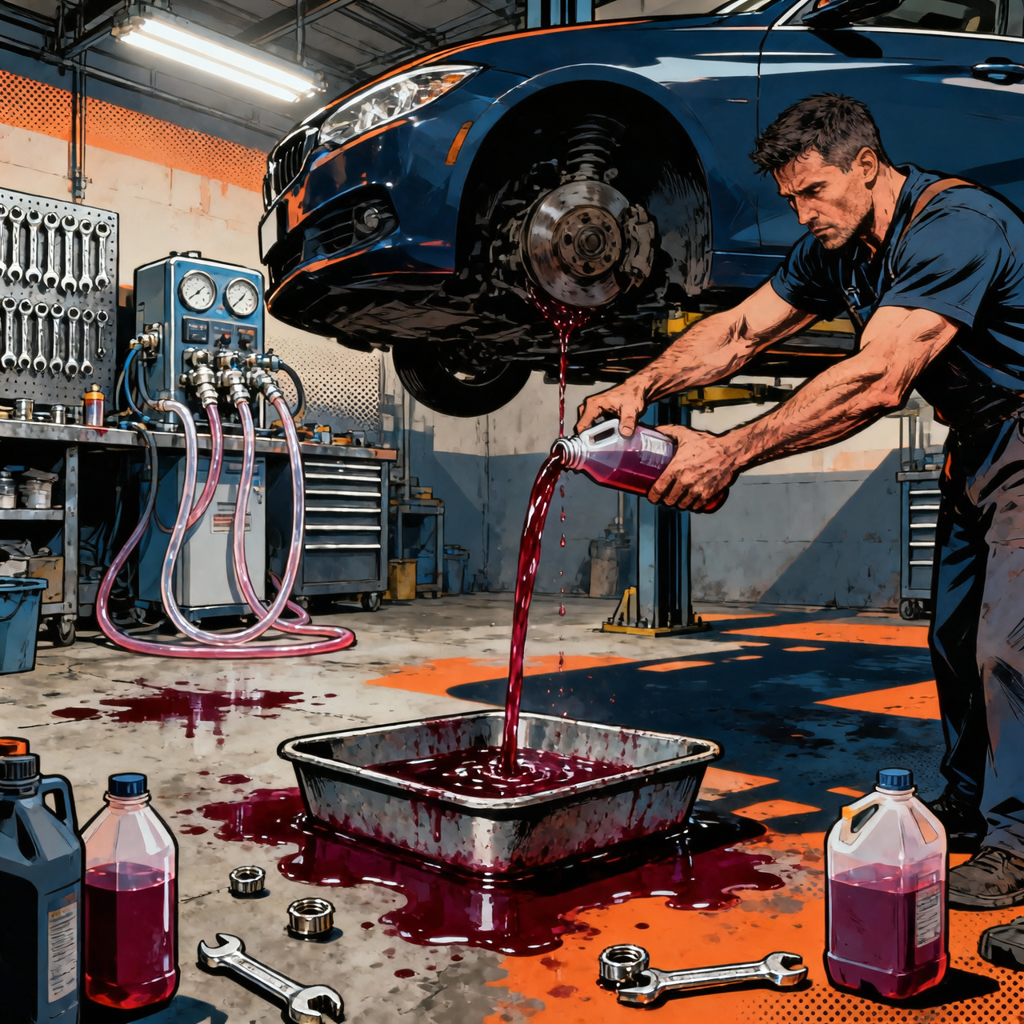
Automatic transmission fluid changes are misunderstood in automotive repair. Different shops recommend different methods—”never touch it,” “flush immediately,” or “drain and fill only.” This confusion stems from concerns about high-mileage transmissions and conflicting manufacturer guidance. This guide provides practical, technician-focused information on when and how to service automatic transmissions.
Drain and Fill vs. Flush: What’s the Difference?
Drain and fill means removing the transmission pan, draining gravity-fed fluid, replacing the filter if accessible, and refilling with fresh ATF. This replaces 30-50% of total fluid because most stays trapped in the torque converter, valve body, and cooler lines.
How drain and fill works and fluid replacement percentages
The transmission pan holds 4-6 quarts while the entire system holds 10-14+ quarts. When you drop the pan, you drain roughly one-third to one-half of total fluid; the rest remains in the torque converter, planetary gears, valve body, and cooler lines. This incomplete swap is actually beneficial for neglected transmissions—old and new fluid mix gradually without shocking the system. Many Toyota and Honda technicians recommend repeating drain and fill every 15,000 miles to slowly replace all fluid over time.
Understanding transmission flush machines and cooler line hookups
Transmission flush machines connect to cooler lines, tapping into the fluid flow between transmission and radiator. The machine captures old fluid and feeds in fresh fluid simultaneously, replacing 90-100% of fluid in one service. Modern machines use the transmission’s own pump rather than external pressure. The technician monitors fluid color through a sight glass and stops once fresh fluid appears consistently. A typical exchange uses 12-20 quarts depending on transmission size.
Why manufacturer recommendations vary by brand
Toyota and Honda specify drain and fill only, explicitly warning against flush machines in technical manuals. Ford and GM dealers commonly use exchange machines as standard procedure. This reflects different engineering approaches: Toyota emphasizes gradual maintenance with external spin-on filters designed for easy service. Honda uses internal screen filters rarely needing replacement. Domestic manufacturers build transmissions with internal paper filters benefiting from regular replacement, making the exchange method attractive. The real factor is maintenance history and current transmission condition, not which method.
Sealed Transmissions: Service Without a Dipstick
“Sealed” or “lifetime fill” transmissions absolutely need service beyond the warranty period. These transmissions aren’t actually sealed—they have fill and drain plugs with specific level-checking procedures using overflow tubes or check plugs accessible from underneath.
Identifying sealed vs. traditional transmission systems
Sealed transmissions lack traditional dipstick access from the engine bay. Examples include BMW ZF 8-speed, Mercedes 722.9, and modern CVTs. Fill plugs typically take 14mm or 24mm hex sockets. Overflow systems set fluid level by filling to the overflow tube length at specific temperatures.
Step-by-step drain and fill procedure for sealed units
Place the vehicle on level ground with transmission at operating temperature (30-50°C, verified via scan tool). Remove the drain plug—some transmissions have both a drain plug and internal filter. Drain completely, reinstall the drain plug with a new crush washer torqued to spec (usually 20-35 ft-lbs). Remove the fill plug and pump in fresh ATF to specification. For overflow systems, pump until fluid runs from the overflow tube, verify temperature is within spec range, and fluid level is correct when dripping slowly from overflow. The ChrisFix YouTube channel has detailed videos on popular sealed transmission designs.
Required tools and OEM fluid specifications
You’ll need: a fluid pump reaching the fill location, a scan tool reading transmission temperature, correct hex sockets, and an 8-quart catch pan. Fluid spec is critical—wrong ATF causes immediate shifting problems or long-term damage. Viscosity and friction modifier packages must match OEM specs exactly. ZF 8-speeds need ZF Lifeguard Fluid 8; using generic Dexron causes harsh shifting and clutch damage. CVTs are even more sensitive—wrong fluid destroys the transmission within miles. Always verify fluid spec on the transmission ID tag or service manual before ordering.
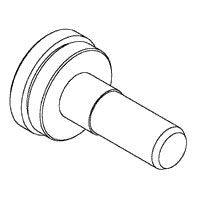
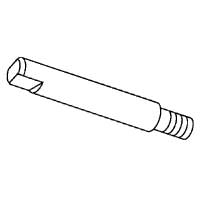
Transmission Fluid Pump Aligner Ford T89T-70010-B
Mfg: OTC Tools and Equipment
Part #: 307-222
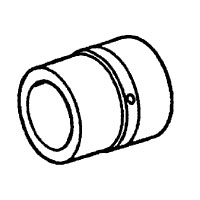
Transmission Fluid Pump Alignment Gauge T74P-77103-B
Mfg: OTC Tools and Equipment
Part #: 307-041
The High-Mileage Dilemma: To Service or Not
The controversial question: should you change fluid on high-mileage transmissions never serviced? Understanding why failures occur helps you decide intelligently.
Risks of first-time service on neglected transmissions
Degraded fluid leaves varnish deposits on clutch packs, valve body components, and passages. These deposits increase friction and restrict passages, creating higher line pressure that compensates for wear. Fresh detergent ATF loosens this varnish, exposing underlying damage. The result: slipping, delayed engagement, or failure shortly after service. Fresh fluid isn’t “too slippery”—it’s revealing wear masked by buildup.
How varnish buildup and debris affect transmission slipping
Transmissions use clutch packs engaged and disengaged by hydraulic pressure. As fluid breaks down, friction modifiers fail, causing heat and wear. Wear particles mix with oxidized fluid forming varnish that increases friction coefficient while blocking valve body passages, pushing up apply pressure. When fresh fluid dissolves varnish, clutch debris circulates. If the transmission has a replaceable filter, debris is caught. With a permanent screen or clogged filter, debris can jam valves or score seals. Worst case: debris jams the pressure regulator valve, causing complete pressure loss.
Decision tree: when to service and when to wait
Under 100,000 miles with unknown history and normal shifting: Drain and fill is generally safe and helpful. Over 150,000 miles with zero previous service and minor issues (slight delay, occasional slip): Risk increases significantly—weigh service cost against replacement cost. Failure is probably coming anyway. Already slipping noticeably or major delays: Fluid service won’t fix it and might worsen it—plan for replacement or rebuild. Regular service every 30,000-50,000 miles: Continue that schedule regardless of mileage. The transmission is healthy. Key factor: Maintenance history, not mileage. A well-maintained 200,000-mile transmission is a better service candidate than a neglected 80,000-mile transmission.

AUTOMATIC TRANSMISSION FLUID EXCHANGER
Mfg: RTi Reading Technologies, Inc
Part #: 400 80009 00
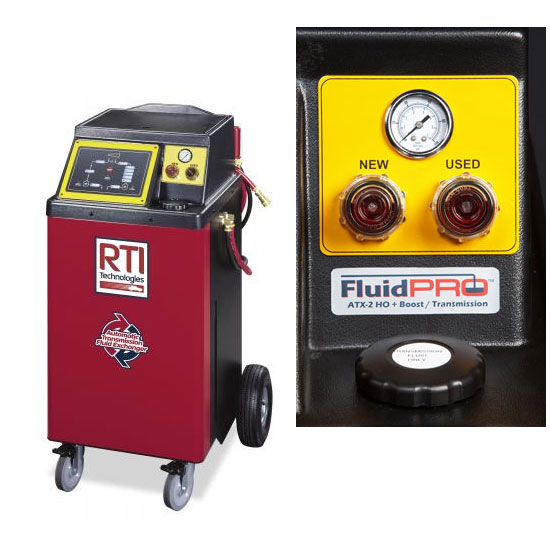
Automatic Transmission Fluid Exchanger
Mfg: RTi Reading Technologies, Inc
Part #: ATX-2BOOST
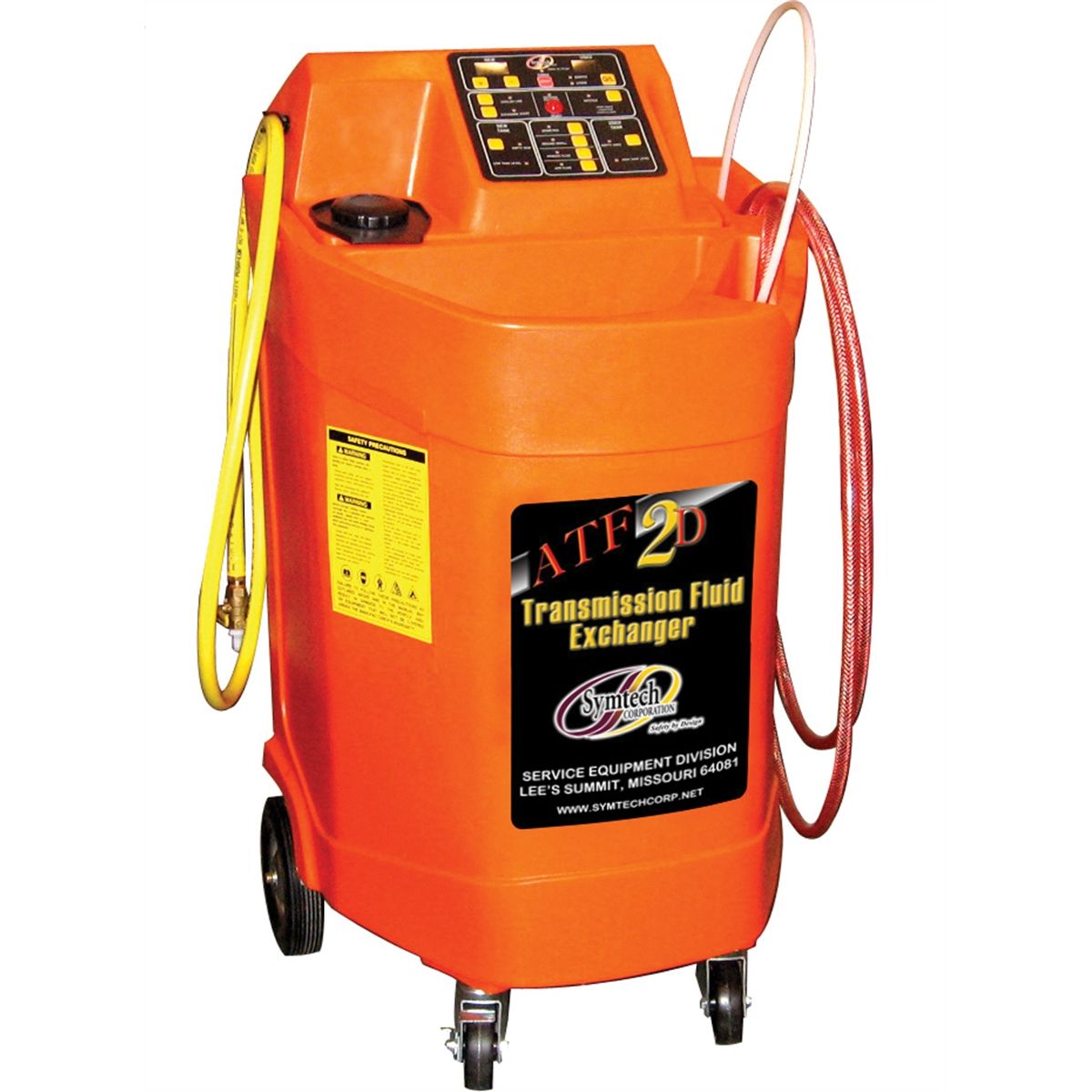
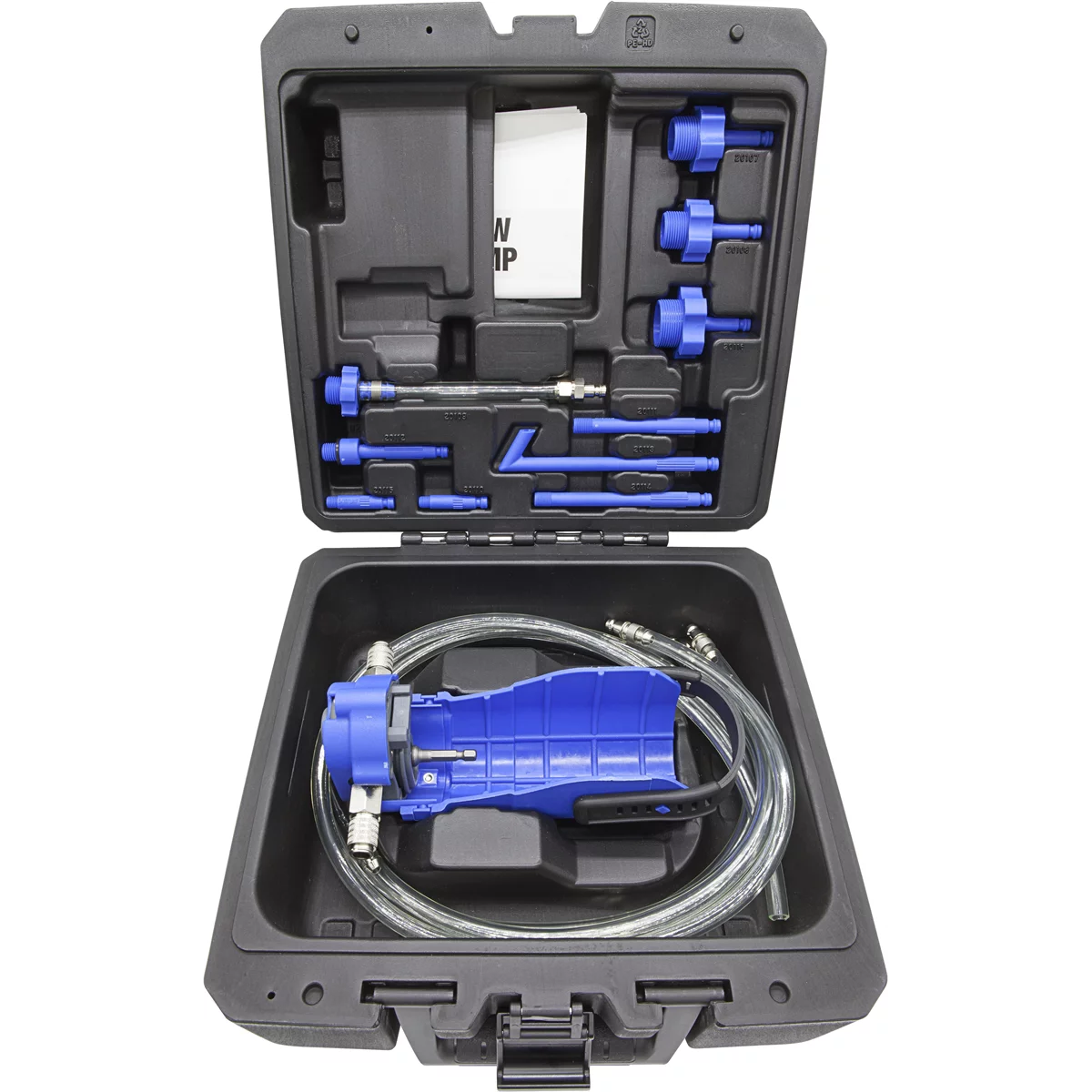
Automatic Transmission Fluid Exchanger, Dipstick Only
Mfg: Symtech Corporation
Part #: 30120000
Cost Breakdown: Dealer vs. Independent vs. DIY
Transmission fluid change pricing varies by service type, shop type, and vehicle complexity.
Pricing comparison across service types and shop types
| Service Type | Dealership Cost | Independent Shop Cost | DIY Cost | Fluid Replaced |
|---|---|---|---|---|
| Basic Drain & Fill | $150-$250 | $100-$175 | $40-$80 | 30-50% |
| Drain & Fill w/ Filter | $200-$350 | $150-$250 | $60-$120 | 30-50% |
| Fluid Exchange/Flush | $250-$400 | $175-$300 | $120-$200 | 90-100% |
| Sealed Trans Service | $300-$500 | $200-$350 | $60-$100 | 30-50% |
These are typical 2024 passenger car costs. Luxury vehicles, large trucks, and expensive OEM-only fluid run higher. Price gaps between dealers and independent shops come down to fluid cost—dealers use OEM-branded fluid while independent shops may use quality aftermarket equivalents meeting the same specs for less.
What you pay for at dealerships vs. independent shops
Dealerships offer: Technicians trained specifically on your transmission, manufacturer technical bulletins addressing known issues, OEM fluid guaranteed to meet specs, and warranty protection if service causes problems. Dealership overhead runs $150-$200/hour versus $80-$120 at independent shops. Independent shops offer: Major cost savings, quality aftermarket fluids meeting or exceeding OEM specs, and sometimes broader transmission knowledge across brands. The drawback: risk of incorrect fluid if specs aren’t verified, and less protection if service causes problems. For routine maintenance on healthy transmissions, independent shops offer great value. For complex sealed transmissions or vehicles with known issues requiring specific procedures, dealer service may be worth the extra cost.
DIY requirements, pitfalls, and when to hire a pro
DIY changes require: jack stands rated for your vehicle, large drain pan, torque wrench, correct sockets, new pan gasket or RTV sealant, replacement filter if applicable, and correct fluid type and amount. Common DIY mistakes: over-tightening pan bolts (causes leaks or cracked pans), under-tightening (guaranteed leaks), using wrong fluid (shifting problems), and improper drain plug torque (leaks or stripped threads). Sealed transmissions require a scan tool reading transmission temperature, correct fill procedures for your model, and patience getting level exactly right. If you lack required tools, can’t safely lift the vehicle, or aren’t sure about fluid spec, professional service is wise. According to Consumer Reports, transmission repairs run $3,000-$5,000, making $200-$300 professional service cheap insurance.
Maintenance Schedules and OEM Requirements
Manufacturer-specific intervals: Toyota, Honda, Ford, and others
Toyota: Check at 30,000 miles under severe conditions; replace only if degraded. Check at 60,000 miles under normal conditions. Most Toyota technicians recommend drain and fill at 30,000-50,000 miles regardless. Honda: 30,000 miles for severe use; relies on Maintenance Minder system for normal use (typically 45,000-60,000 miles). Ford: 150,000 miles for many recent models (most technicians find unrealistic). GM: 45,000-97,500 miles depending on model. European makers: Often claim “lifetime” fill but dealerships suggest service at 60,000-80,000 miles for vehicles past warranty. Safest approach: Follow severe service schedule regardless of driving style; never exceed 60,000 miles between services.
Why fluid type matters: viscosity and compatibility issues
Modern transmissions require specific formulations: Toyota WS, Honda DW-1, Ford Mercon LV, GM Dexron VI, Mopar ATF+4, and CVT-specific fluids. These differ in viscosity, friction modifiers, additives, and seal compatibility. Wrong fluid causes harsh shifting, seal leaks, or clutch damage. Viscosity affects shift feel—too thick causes sluggish cold shifts; too thin slips under load. Friction modifiers are specific to clutch materials; mismatches cause shudder or chatter. Always check the transmission ID tag, owner’s manual, or NHTSA specs. If unsure, use OEM fluid—it costs more but eliminates compatibility risk.
CVT transmission fluid service differences and considerations
Continuously variable transmissions use belts or chains between variable-diameter pulleys instead of gear sets with clutch packs. CVT fluid must provide precise friction—too much causes grabbing and shudder; too little causes slipping and wear. CVT fluid cannot be swapped with conventional ATF. CVT service intervals are shorter: 30,000-60,000 miles per manufacturers, though experienced technicians recommend 30,000-40,000 miles or as often as 25,000 for severe use. CVTs don’t tolerate degraded fluid and fail early when maintenance is skipped. Drain and fill is standard—flush machines aren’t recommended due to CVT hydraulic control sensitivity. Failed CVTs cost $4,000-$7,000 installed and often aren’t economically rebuildable. Frequent fluid service is cheap insurance.
Pre-Service Transmission Inspection Checklist
- Check fluid level and condition: Note color (should be red or pink; brown or black indicates degradation), burnt smell (overheating damage), and debris or metal particles
- Review service history: Confirm last service date, mileage, type of service, and fluid type used
- Road test evaluation: Test shifts under light and moderate acceleration; watch for delays, slips, or flares; verify torque converter lockup; check for shudder or vibration
- Scan for codes: Check for transmission codes indicating problems fluid service won’t fix
- Inspect for leaks: Check pan gasket, cooler lines, axle seals, and front pump seal
- Verify fluid specification: Confirm correct fluid type using transmission ID tag, manual, or manufacturer information
- Assess risk factors: Consider mileage, service history, current symptoms, and budget before recommending service type
- Document baseline condition: Note current shift quality for post-service comparison
Frequently Asked Questions
Is it better to drain and fill or flush a transmission?
Drain and fill is safer and more conservative, replacing 30-50% of fluid gradually over multiple services. Toyota and Honda technicians prefer this for unknown service history. Fluid exchange replaces 90-100% in one service using cooler line hookup, more thorough but riskier on neglected transmissions. For regularly maintained transmissions, either works. For high-mileage or poorly maintained units, drain and fill is much safer.
What happens if you change transmission fluid on a high-mileage car never serviced?
If the transmission shifts normally, drain and fill usually improves operation and extends life. If wear is hidden by varnish deposits, fresh fluid can expose underlying damage, potentially causing slipping or failure shortly after service. It’s not the new fluid—it’s revealing existing wear masked by buildup. Risk increases with mileage and neglect severity. On transmissions over 150,000 miles with zero service history, you’re deciding between risking service or accepting probable failure.
How much transmission fluid actually gets replaced in a typical service?
Basic drain and fill replaces about 30-50% because most fluid stays trapped in the torque converter, valve body, cooler lines, and passages. On a 12-quart system, you drain only 4-6 quarts. Fluid exchange services connected to cooler lines replace 90-100% by using the transmission’s pump to circulate fluid while capturing old fluid and feeding fresh fluid simultaneously.
Do sealed transmissions really never need service?
“Sealed” or “lifetime fill” means warranty period, not vehicle lifespan. All transmission fluid breaks down from heat, oxidation, and contamination. Sealed transmissions absolutely benefit from service every 50,000-80,000 miles depending on use. “Sealed” just means no traditional dipstick—these transmissions have fill and drain plugs and can be serviced with proper procedures. Skipping service causes the same early failure as conventional transmissions.
Can I use aftermarket transmission fluid instead of OEM?
Quality aftermarket fluids meeting or exceeding OEM specs are generally fine and save money. The key is matching exact specs—viscosity grade, friction modifier package, and additives. Reputable makers like Valvoline, Mobil, and Castrol make fluids engineered to specific OEM specs. Avoid generic “universal” fluids claiming compatibility with multiple specs—these compromised formulations rarely optimize for any specific transmission. Verify aftermarket fluid specifically meets your transmission’s needs and keep documentation.
How often should CVT transmission fluid be changed?
CVTs need more frequent service than conventional automatics due to fluid sensitivity. Manufacturers specify 30,000-60,000 mile intervals; experienced technicians recommend 30,000-40,000 miles or even 25,000 for severe use. CVTs don’t tolerate degraded fluid and fail early when maintenance is skipped. CVT replacement costs $4,000-$7,000 and many aren’t economically rebuildable. Frequent fluid service is cheap insurance.

TRANSMISSION JACK 1 TON WITH TCHS HYDRAULIC KIT
Mfg: Mahle Service Solutions
Part #: 3004905

Now that you understand the difference between transmission fluid drains and flushes, you’ll need the right tools and products to complete the job. Our transmission repair category has everything you need to maintain your vehicle’s transmission system.
Essential products for your transmission service:
- Transmission fluid pumps and extractors for safe, mess-free fluid removal
- Premium transmission fluids matched to your vehicle’s specifications
- Drain pans and fluid disposal kits for proper waste management

The Toolsource Technical Team blends decades of real-world automotive service experience with up-to-date technical research. Our writers collaborate with professional mechanics, shop owners, and diagnostic specialists to deliver practical, workshop-ready guidance you can trust.


Follow us on social media