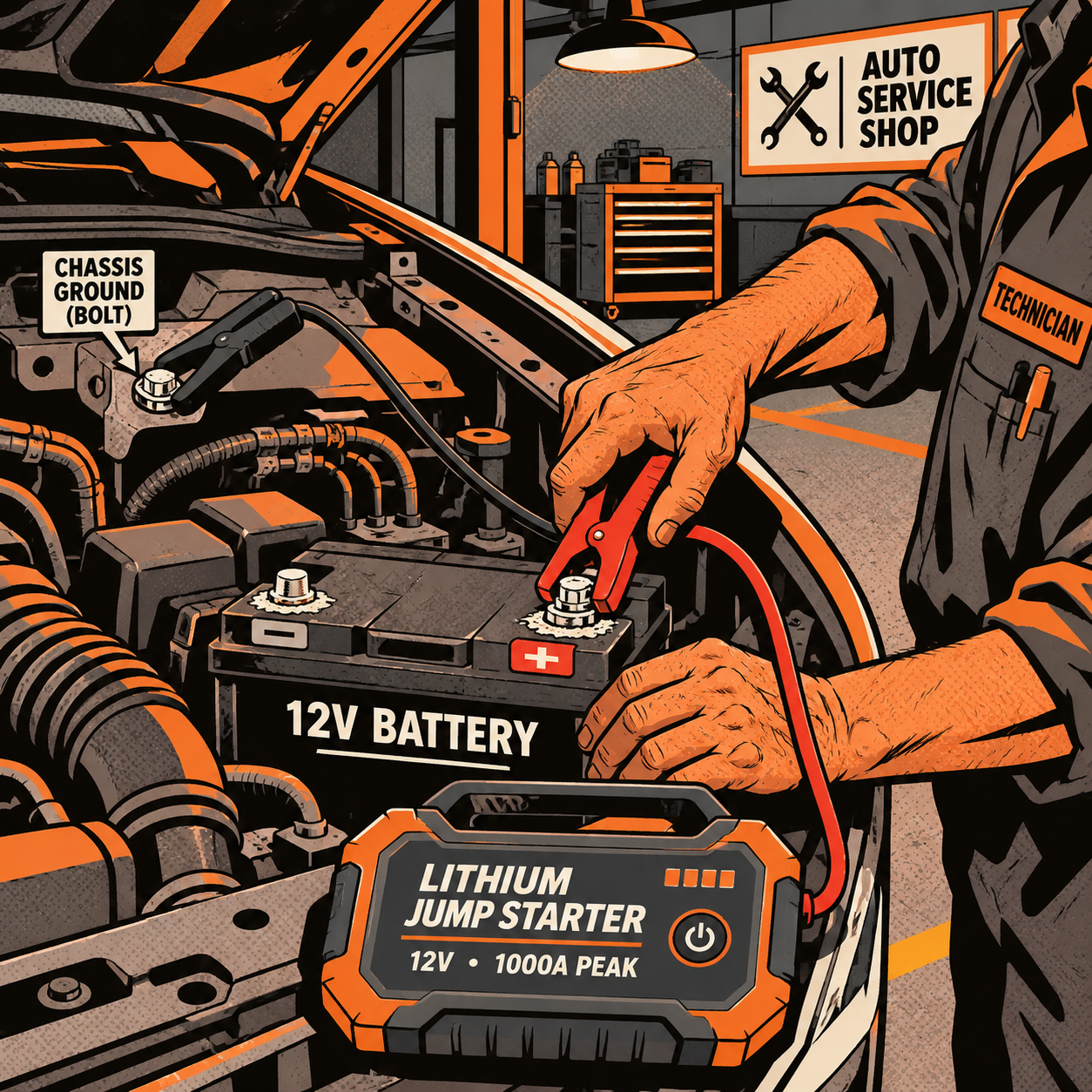
A dead battery is one of the most common roadside calls a technician will run into, and the gear you carry to handle it matters as much as the technique. Lithium-ion jump starters have largely replaced the old jumper cable and donor-car routine, but there’s still a right way and a wrong way to pick one, use one, and confirm the battery underneath the problem is actually fixed. This guide walks through selecting a jump starter, the safe jump procedure, and the testing steps that separate a real fix from a temporary save.
Why a Compact Jump Starter Belongs in Every Van and Glove Box
Traditional jumper cables require a second running vehicle, decent clearance to get bumper-to-bumper, and enough cable length to reach both batteries. That’s not always available — on a job site, in a parking garage, or on a shoulder with no safe place for a donor car to pull up. A compact lithium jump starter solves that by putting the power source in your hand. Most units in the 12-18V, 1000-3000 peak-amp range will start anything from a compact sedan up to a mid-size truck or diesel pickup with the higher-capacity models.
The appeal for a tech isn’t just convenience — it’s reliability under pressure. A unit that lives in a door pocket or tool bag, stays charged, and takes 30 seconds to clamp on beats hunting for a volunteer with cables every time. Several of these packs double as USB power banks and flashlights, which is useful but secondary — the clamps and peak-amp rating are what matter for the actual job.
Choosing the Right Jump Starter for the Work You Do
Not every jump starter is built the same, and the “more features” unit isn’t always the better buy for field work. A few things to check before buying:
- Peak amps vs. cranking amps: Match the rating to the largest vehicle you’ll realistically jump. Diesels and big V8s need more sustained cranking power than the peak-amp number alone suggests.
- Clamp quality: Cheap spring clamps lose grip on corroded or recessed terminals. Look for reverse-polarity protection and a secure bite.
- Reverse-polarity and spark protection: Non-negotiable. A unit without this protection can damage the vehicle’s electronics or cause a short if the clamps are reversed.
- Dedicated charger vs. all-in-one diagnostic tool: Multi-function testers that combine a charger, battery analyzer, and OBD scanner are useful in a shop, but for a quick jump or top-off, a simple dedicated jump pack or charger is often faster and more reliable than a feature-heavy diagnostic unit that’s overkill for the task at hand. Buy the diagnostic tool for diagnostic work; buy the simple charger for simple charging.
- Battery chemistry and cold rating: Lithium packs lose some capacity in cold weather. If you work in a cold climate, check the unit’s rated performance at low temperatures, not just its room-temperature spec.


3000A 12V/24V Lithium Battery Jump Starter and Powerbank
Mfg: GearWrench
Part #: GWLBJ30
Jump-Starting Safely, Step by Step
The procedure is simple, but skipping steps is how clamps get crossed or sparks land near a battery that’s venting hydrogen. Follow this order every time:
- Confirm the jump starter is charged and inspect clamps for corrosion or damage.
- Turn off the vehicle’s accessories (lights, HVAC fan, infotainment) before connecting.
- Connect the positive (red) clamp to the positive battery terminal first.
- Connect the negative (black) clamp to a solid ground point — a chassis bolt or bracket, not the battery’s negative post, especially if the battery shows any sign of corrosion or gas buildup.
- Power on the jump starter if it has an activation switch, then attempt to start the vehicle.
- If it doesn’t fire within a few seconds, stop, check connections, and give the pack a short rest before trying again — holding the crank for extended periods wastes charge and risks overheating the starter.
- Once running, remove clamps in reverse order: negative first, then positive.
Skip improvised jumps whenever possible. Using mismatched tool batteries, bare metal, or household items to bridge a dead battery has worked in true emergencies, but it carries real risk — uncontrolled current paths, sparking near battery gases, and tool battery damage. It’s a last resort, not a method, and it’s not something to rely on or recommend to a customer.
Testing Battery Health Before You Ever Reach for Clamps
A jump starter fixes the symptom, not the cause. If a battery is weak enough to need a jump, that’s a flag to test it, not just recharge it and move on. A basic digital multimeter or a dedicated battery/load tester will tell you more in two minutes than guessing based on how slowly the engine cranked.
- Resting voltage: With the vehicle off for at least an hour, a healthy 12V battery should read around 12.4-12.6V. Anything consistently below 12.2V indicates a battery that’s discharged or degrading.
- Load test: A voltage reading alone doesn’t catch a battery with good surface charge but failing internal plates. A load or conductance tester will expose that.
- Parasitic drain check: If a vehicle sits for one to three weeks and comes back with a dead or marginal battery repeatedly, suspect a parasitic draw — an interior light, aftermarket alarm, or module that isn’t sleeping properly — rather than blaming the battery every time.
Confirming the Fix: What to Check After Charging
This is the step that gets skipped most often, and it’s the one that prevents a repeat call. After a jump-start or a full charge, don’t just assume the battery is good because the engine started. Check it again once it’s had time to settle:
- Re-check voltage after the vehicle sits overnight (or at least a few hours) with everything off. A battery that reads fine immediately after charging but drops fast overnight is telling you it can’t hold a charge — that’s a battery that needs replacing, not another jump.
- Re-test under load once the surface charge has settled, not immediately off the charger, since a fresh surface charge can mask a weak battery on a quick voltage check.
- If a battery has been sitting unused for several weeks before a trip, test it the day before, not the day of. A marginal battery that’s been slowly draining will often show a borderline reading days in advance, giving you — or your customer — time to charge or replace it instead of getting stranded.
Quick Reference Checklist
- Jump starter charged and clamps inspected before it goes back in the van or glove box
- Vehicle accessories off before connecting clamps
- Positive clamp to battery terminal, negative clamp to chassis ground
- Resting voltage checked (12.4-12.6V healthy baseline)
- Load test run if voltage is borderline or the vehicle has a history of weak starts
- Battery re-checked after sitting a few hours to confirm it’s actually holding charge
- Parasitic drain investigated if the same vehicle keeps coming back dead

Digital Battery /Charging System Tester PBT100 w/ Voltmeter (MID
Mfg: Midtronics
Part #: PBT-100
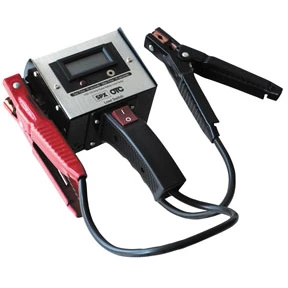

Auto Meter BVA-260 Handheld Electrical System Tester
Mfg: Auto Meter
Part #: BVA-260
Frequently Asked Questions
How often should I recharge a jump starter that’s sitting unused in a vehicle or tool bag?
Check it monthly. Lithium jump starters self-discharge slowly, but extreme heat or cold in a vehicle accelerates that. A pack that reads low when you actually need it is worse than not carrying one at all.
Can connecting the negative clamp to the battery terminal instead of a ground point cause damage?
It can increase the risk of a spark igniting hydrogen gas that collects near the battery, especially on an older or heavily discharged battery. Using a chassis ground point away from the battery is the safer standard practice.
My jump starter won’t start a vehicle even though it shows a full charge — what’s wrong?
Check the clamp connection first — corrosion or a loose grip on the terminal is the most common cause. If connections are solid, the vehicle’s battery may be too deeply discharged or internally damaged for a jump pack’s peak-amp output to overcome, and it likely needs replacement rather than another charge attempt.
Is it safe to jump-start a vehicle using a power tool battery in an emergency?
It has worked for people in a genuine no-other-option situation, but it’s not a recommended method. Tool batteries aren’t designed for automotive cranking loads, voltage and current aren’t controlled the way a purpose-built jump starter controls them, and the risk of sparking or damaging the tool battery is real. Treat it as a last resort, not a technique to plan around.
Why does a battery test fine right after charging but fail a day later?
A surface charge builds up on the plates during charging and can produce a normal-looking voltage reading immediately afterward, even on a failing battery. Letting it rest and re-testing removes that surface charge and gives a true picture of whether the battery can actually hold voltage.
What’s a normal amount of voltage drop overnight for a healthy battery?
A healthy battery with no parasitic drain should lose only a few hundredths of a volt overnight. A drop of several tenths of a volt or more points to either a weak battery or something drawing current while the vehicle is off.
Shop Booster Packs
With a clear picture of what peak-amp rating, clamp quality, and safety features match your vehicle mix, explore our selection of portable lithium booster packs for field work and emergency use.
- Compact units rated 1000–3000 peak amps for different vehicle classes
- Clamps with reverse-polarity protection and stable grip on corroded terminals
- Dedicated jump starters and combination charger-diagnostic tools

The Toolsource Technical Team blends decades of real-world automotive service experience with up-to-date technical research. Our writers collaborate with professional mechanics, shop owners, and diagnostic specialists to deliver practical, workshop-ready guidance you can trust.


Follow us on social media