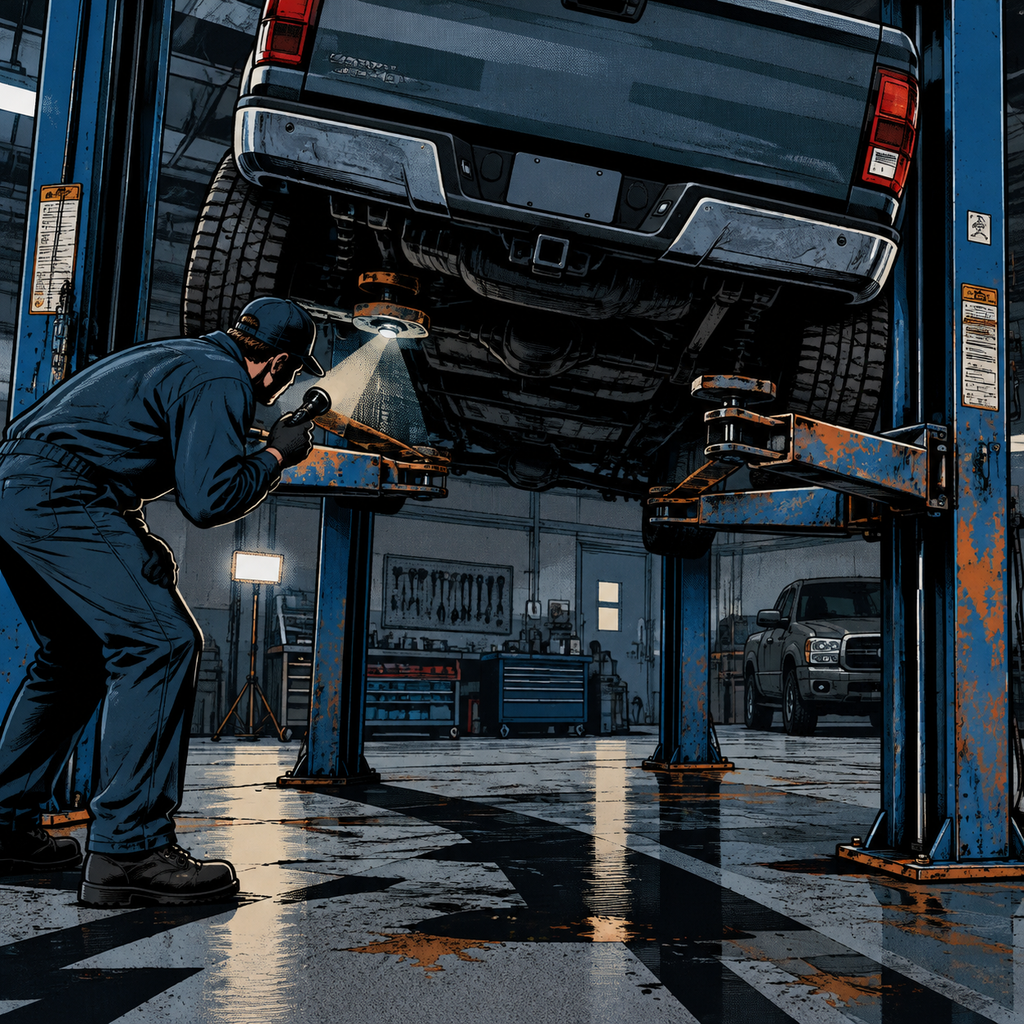
A truck left crooked on a lift overnight is one of the fastest ways to turn a normal Monday into a shouting match. The underlying safety concern is legitimate — an improperly racked vehicle can fall, and that’s a real injury or fatality risk — but how that concern gets communicated varies wildly from shop to shop. This guide separates the two issues that tend to get tangled together in these situations: the mechanical safety check you need to run every time you approach a lift, and the interpersonal fallout when a senior tech handles the correction poorly. Knowing how to do both well protects your body and your paycheck.
Why an Improperly Racked Vehicle Is a Big Deal
Lift arm placement isn’t a cosmetic detail. Every vehicle has specific lift points designed to center weight over the arms and keep the frame or pinch welds from being crushed or slipping off the pads. When a vehicle is “too far up,” “crooked,” or sitting on arms that aren’t fully engaged, the center of gravity shifts. A lift that looks stable can still be seconds away from a slip, especially once someone starts torquing on suspension components, rocking the vehicle, or bouncing on a jack handle underneath it.
This is why experienced techs react fast and hard when they see it — they’ve either seen a vehicle come off a lift or heard about it happening to someone they knew. That urgency is usually sincere, even when the delivery is rough. Separating “this person is right about the hazard” from “this person is being a jerk about how they said it” is the first mental step to take before reacting.
The Correct Response When You Find a Vehicle Racked Wrong
Whether you racked it or found it that way, the procedure is the same. Don’t get defensive first — get safe first.
- Stop and don’t touch the controls yet. If the vehicle is already elevated and clearly unstable, don’t start working under it or moving arms until you’ve assessed it from the outside.
- Check arm engagement visually. Confirm all four lift pads are seated on the manufacturer’s lift points, not on rocker panels, exhaust, or suspension components.
- Check the locking mechanism. Make sure the safety locks or lock pins are actually engaged, not just resting on hydraulic pressure.
- Lower slowly if repositioning is needed. Bring the vehicle down in a controlled motion, readjust the arms at ground level, and re-raise it a few inches at a time, rechecking contact points as you go.
- Document who had the vehicle last. If you didn’t park it, note it on the repair order or tell the shop foreman so the responsibility trail is clear — not to assign blame in the moment, but so the pattern doesn’t repeat.
None of this requires raising your voice. A simple “I didn’t bring this one in, I’m lowering it to re-rack it now” handles both the safety issue and the ownership question in one line.
{{PRODUCT_SEARCH_1}}

Atlas 9,000 lb. Capacity Overhead 2-Post Lift FREE FREIGHT
Mfg: Atlas Automotive
Part #: TPO-9


Atlas Automotive Equipment 8,000 lb Air/Hydraulic Rolling Bridge
Mfg: Atlas Automotive
Part #: RJ-8A ROLLING JACK
De-escalating a Confrontation With a Senior Tech
Shops run on hierarchy, and a lot of senior techs switch to a sharper tone the instant they see something that could get someone hurt — that’s a different register than their normal day-to-day voice, and it’s worth recognizing the difference rather than reading it as a personal attack. The goal in the moment isn’t to win the exchange, it’s to get back to a working relationship as fast as possible.
A few things that consistently work on the shop floor:
- State the fact, then move. “Wasn’t me, fixing it now” and then physically start the fix. Action defuses faster than argument.
- Don’t match escalating volume. Matching tone turns a correction into a fight. Keeping your own volume flat tends to bring the other person down with you within a sentence or two.
- Set a boundary once, clearly, and stick to it. “I hear you, I’m handling it — I need you to step back now” said once and repeated verbatim if they keep pushing works better than escalating language each time.
- Physically disengage if someone follows you to keep arguing. Walking to a break room or restroom and stating you need a minute is a normal, defensible move — it is not the same as walking out for the day.
There’s a meaningful difference between a senior tech barking a correction once and someone tailing a coworker around the shop continuing to argue after being asked to stop. The first is standard (if blunt) shop culture. The second is a conduct problem regardless of how senior the person is or how valid their original point was.
When to Loop In a Manager — and When Not To
Going to a manager over every sharp word will earn a reputation fast, and not the kind that helps you. Save it for patterns, not single incidents:
- One-off correction, even a loud one, about an actual safety issue: handle it yourself, move on.
- Repeated daily targeting from one person, confirmed by other techs who’ve noticed it too: that’s worth a direct, calm conversation with a manager — not as a complaint about getting yelled at, but as a pattern report with specifics (dates, what was said, witnesses).
- Someone physically following you and refusing to stop after you’ve asked for space: that crosses from “shop culture” into a conduct issue a manager needs to act on immediately, not “tomorrow.”
If you do escalate, be precise about what you’re asking for. “I need him to stop following me and talking at me after I’ve asked for space” is actionable. “He’s mean to me” isn’t, and it puts the manager in a position to minimize it.
Reading Your Shop’s Culture Accurately
Every shop has some level of blunt talk, and new techs get corrected more sharply than techs with ten years in. That’s normal friction, not dysfunction. What separates a tough-but-fair shop from a genuinely toxic one is whether the correction stops once the point is made, whether multiple senior techs reinforce the same behavior, and whether management treats safety-related flare-ups as something to coach rather than ignore.
If one person is a consistent outlier — other techs privately agree he goes too hard, management acknowledges it’s “not right” but doesn’t act — that’s useful information about the shop, not proof that you’re too sensitive for the trade. Chain shops in particular tend to have high turnover and thinner management bandwidth to deal with personality problems, which is part of why the same complaint pattern (one miserable senior tech riding new hires) shows up across so many of them.
{{PRODUCT_SEARCH_2}}
Quick Lift-Safety Checklist
- All four pads seated on correct lift points, not on panels or suspension parts
- Vehicle centered — no visible lean before raising past a few inches
- Safety locks/pins engaged before working underneath
- Arms rechecked after any height adjustment
- Last person to park/rack the vehicle noted on the RO if it wasn’t you

FAQ
Who’s responsible if a vehicle was racked wrong by someone else overnight?
Whoever finds it is responsible for not working under it until it’s corrected, regardless of who racked it. Fault for how it got that way is a separate conversation — handle the hazard first, assign responsibility after.
Is it normal for senior techs to raise their voice over safety issues?
It’s common, especially around lift and jack-stand incidents, because experienced techs have usually seen or heard about someone getting hurt this way. A sharp tone over a genuine hazard is different from ongoing personal targeting — the first is typical shop culture, the second is a conduct problem.
How do I tell the difference between normal “shop talk” and harassment?
Normal shop talk is situational — it happens around a specific mistake or hazard and ends once it’s addressed. Harassment is targeted, repeats regardless of performance, continues after you’ve asked for space, or involves someone following you to keep arguing. If multiple coworkers independently notice the same pattern, trust that signal.
Should I leave a chain shop like Firestone or Pep Boys for an independent or dealership?
Not automatically — plenty of techs build solid foundational skills at chain shops. But if management consistently fails to address a known behavior problem after it’s reported, that’s a legitimate reason to start applying elsewhere rather than waiting for it to improve.
What should I say in an interview about leaving a shop over a conflict?
Frame it around what you’re looking for, not what you’re escaping: “looking for a team-oriented shop with stronger mentorship” lands better than detailing a specific blowup, even if the blowup is exactly why you’re leaving.
Can a tool truck rep help me find a better shop?
Route reps who service multiple shops in an area often know which ones have reasonable management and which have reputations for churn. It’s worth asking, though treat it as one data point alongside reviews and talking to current employees.
Recommended Lifting Equipment
Safe vehicle handling starts with reliable equipment. Our lift selection covers equipment with certified weight capacities and dependable locking mechanisms — the core tools for the safety verification you need to run every time you approach a vehicle.
- Two-post and four-post lifts with certified load ratings
- Safety lock and mechanical stop features
- Lift maintenance and pad inspection resources

The Toolsource Technical Team blends decades of real-world automotive service experience with up-to-date technical research. Our writers collaborate with professional mechanics, shop owners, and diagnostic specialists to deliver practical, workshop-ready guidance you can trust.


Follow us on social media