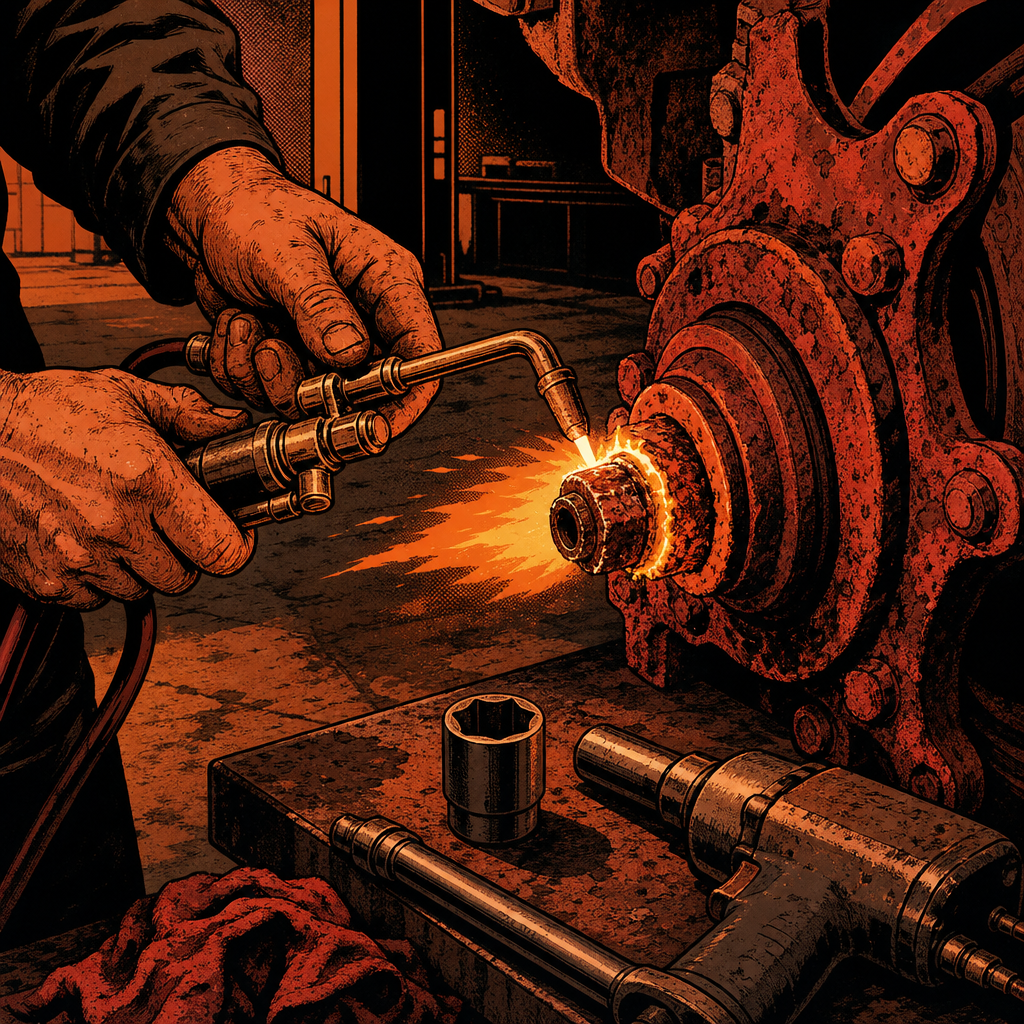
Anyone who has spun a wrench in a salt-belt shop knows the feeling: the socket seats perfectly on the axle nut, the impact gun screams, and nothing moves. What used to be a hex or twelve-point fastener has become a solid mass of rust bonded to the spindle and axle shaft. This isn’t a torque problem, it’s a corrosion problem, and treating it like a torque problem just rounds off corners and burns out impact guns. The following methods reflect what working technicians actually reach for when a nut is welded on by rust rather than threads, in order from least to most destructive.
Understand Why the Nut Won’t Break Loose
An axle nut sees constant exposure to road spray, salt brine, and temperature cycling. Moisture wicks into the threads, oxidizes the steel, and the resulting iron oxide takes up more volume than the metal it replaced. That expansion locks the nut onto the shaft with a bond that has nothing to do with the original torque spec. On vehicles that see winter road salt for a decade or more, it’s common for the nut, washer, and shaft to corrode into what is effectively one part. Recognizing this up front changes the approach: you’re not loosening a fastener, you’re breaking a corrosion bond or removing material entirely.
Start With Heat Before You Reach for Bigger Tools
Heat is the first and most reliable step because it does two things at once: it expands the nut faster than the shaft (freeing some clearance) and it burns off the rust and oxide layer that’s acting as the bonding agent. A few heat sources come up repeatedly in shop discussions, each with tradeoffs:
- MAP-gas torch — accessible and cheap, but underpowered for heavily rusted axle hardware. Works on light corrosion, struggles on anything that’s been rusting for years.
- Oxy-acetylene torch — the classic choice, and still the fastest way to get a nut cherry red. A properly set neutral flame will get through even severe corrosion in under a minute, and the same rig doubles as a cutting torch if the nut needs to come off entirely.
- Induction heater — an increasingly popular alternative that heats the fastener directly through eddy currents rather than an open flame, which matters in shops near fuel lines, brake lines, or interior trim. Entry-level induction heaters can run $150 and last for years of regular use, but low-wattage “stick” style units often aren’t strong enough to fully break down heavy rust — you need a mid-to-high wattage unit (roughly 2000-3000 watts) with a properly sized coil to get the fastener glowing and crack the rust loose.
Whichever method you use, heat the nut itself, not the shaft, and work in short cycles — heat, hit with penetrating oil or wax-based lubricant, let it cool slightly, then attempt removal.
{{PRODUCT_SEARCH_1}}

Apply Mechanical Force the Right Way
Once the nut has been heat-cycled, mechanical force does the rest. A few points matter more than raw torque:
- Always use a six-point socket, not a twelve-point, on a corroded nut. Twelve-point sockets ride on the corners and are far more likely to round off a nut that’s already lost some definition to rust.
- A high-torque impact gun is the standard tool here, but on severely bonded nuts even a strong impact will just spin and heat the socket without breaking the nut free — that’s a sign you need another heat cycle, not a bigger gun.
- An air hammer with a long-barrel bit, used to shock the nut with repeated sharp impacts (sometimes called “ugga-dugga” hits in shop slang), can break the corrosion bond even when steady impact torque fails. Vibration disrupts rust bonding in a way that constant force doesn’t.
- A 10-pound sledge and a stout breaker bar remain valid tools when power tools aren’t cutting it, especially combined with fresh heat.
When to Cut Instead of Loosen
Some nuts are past the point of being “removed” in the conventional sense. If the nut has rusted into a shapeless lump, or if heat and impact together aren’t budging it after two or three cycles, cutting is the faster and safer path:
- Cutting torch — with the axle already hot from the heating step, transitioning straight to a cutting tip lets you slice the nut off in well under a minute, though plan on extra time to clean slag and debris out of the threads afterward.
- Split with a chisel — a sharp cold chisel placed to split the nut 180 degrees apart is a reliable manual method when a torch isn’t available or isn’t safe to use (near fuel lines, interior components, etc.). This works whether or not the axle shaft itself is salvageable.
- Plasma cutter — faster and more precise than an oxy torch for shops that have one, particularly useful when working close to other components you don’t want to scorch.
Before cutting, make a call on the axle shaft. If the shaft threads are already damaged or the CV joint is being replaced anyway, don’t waste time trying to preserve the nut or the threads — cut for speed. If the shaft is being reused, cut carefully to avoid nicking the shaft itself, and plan to chase the threads afterward.
Work Safely Around Fuel, Brake, and CV Components
Axle nuts sit close to CV boots, brake lines, and sometimes fuel lines, so open-flame work carries real risk of collateral damage. A few practical safeguards:
- Shield rubber CV boots and brake lines with a heat-resistant blanket or wet rag before torching nearby.
- Keep a fire extinguisher within reach any time a torch is in use, and never heat near a leaking or recently disconnected fuel line.
- If the vehicle has ABS tone rings or sensors on the hub, keep flame away from them — they’re far more heat-sensitive than the surrounding steel.
- Induction heaters are the safer choice in tight engine bays or near plastic/rubber components since they don’t produce an open flame, even though they take longer to reach full heat than a torch on a well-matched coil.
Prevent the Next Seized Nut
Whatever method frees the nut this time, take the extra few minutes during reassembly to make the next service easier:
- Clean the shaft threads fully and chase them with a die if there’s any rust pitting.
- Apply a thin coat of anti-seize compound to the threads and nut face before torquing to spec — avoid the bearing/hub mating surfaces where anti-seize can affect torque readings.
- Note the axle nut torque spec and re-torque procedure for the vehicle; over-tightening doesn’t prevent corrosion and just makes the next removal worse.
- In heavy road-salt regions, consider a dab of anti-seize or a light corrosion-inhibiting spray on the nut annually if the vehicle is up on a lift for other work.
Quick Checklist: Freeing a Seized Axle Nut
- Confirm you’re using a six-point socket sized correctly for the nut
- Heat the nut (torch or induction heater) in short cycles, not the shaft
- Apply penetrating oil between heat cycles and let it wick in
- Try a high-torque impact gun; if it spins without breaking loose, reheat
- Switch to an air hammer or sledge/breaker bar combo if impact alone fails
- If still stuck after 2-3 cycles, cut the nut with a torch, plasma cutter, or split it with a chisel
- Shield nearby rubber, brake lines, and sensors before any open-flame work
- Chase threads, apply anti-seize, and torque to spec on reassembly
{{PRODUCT_SEARCH_2}}
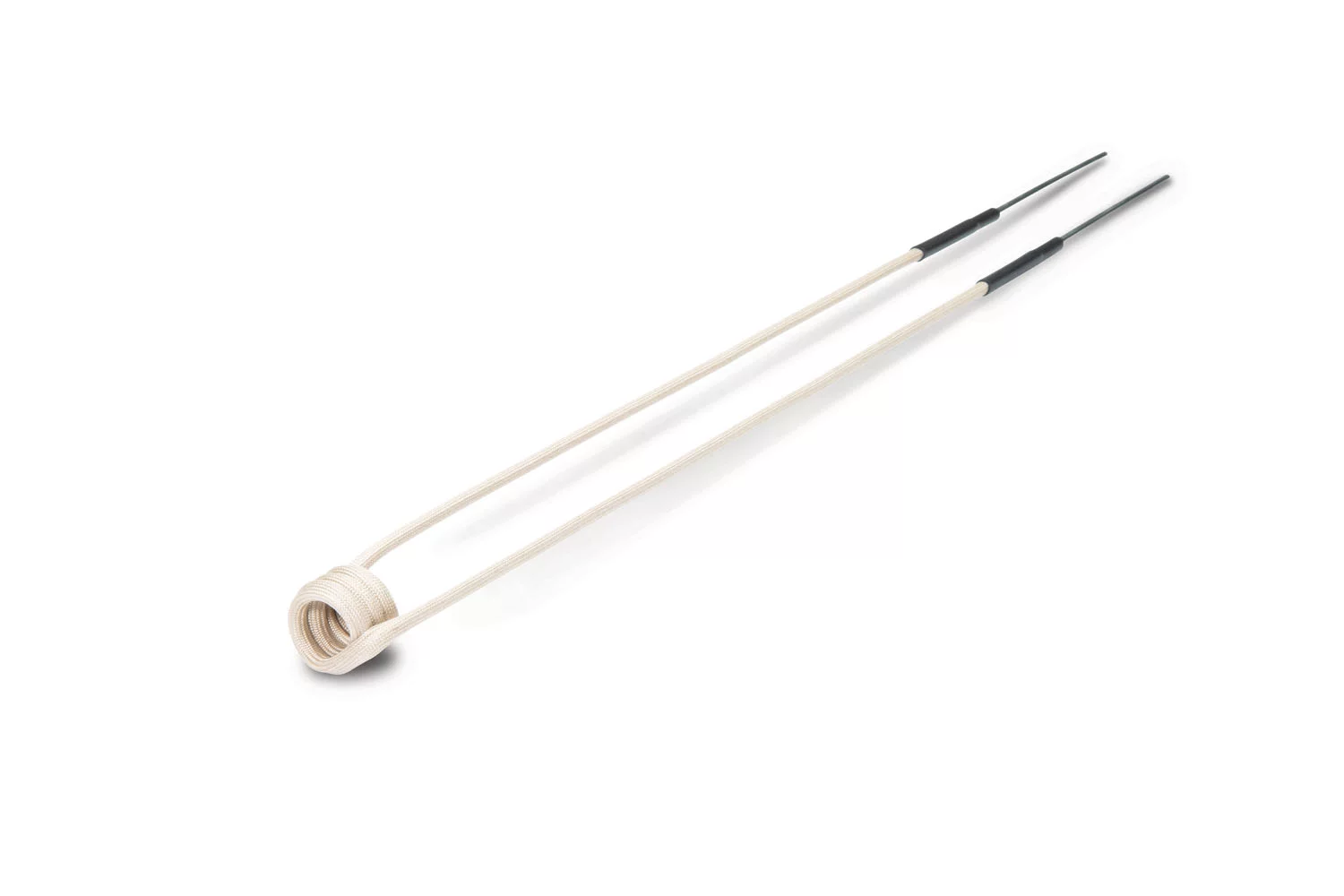
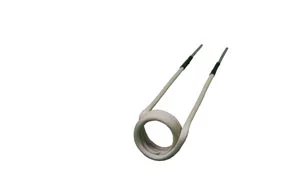
Preformed Coil for Mini-Ductor 1-1/4 Inch I.D.
Mfg: Induction Innovations
Part #: MD99-609
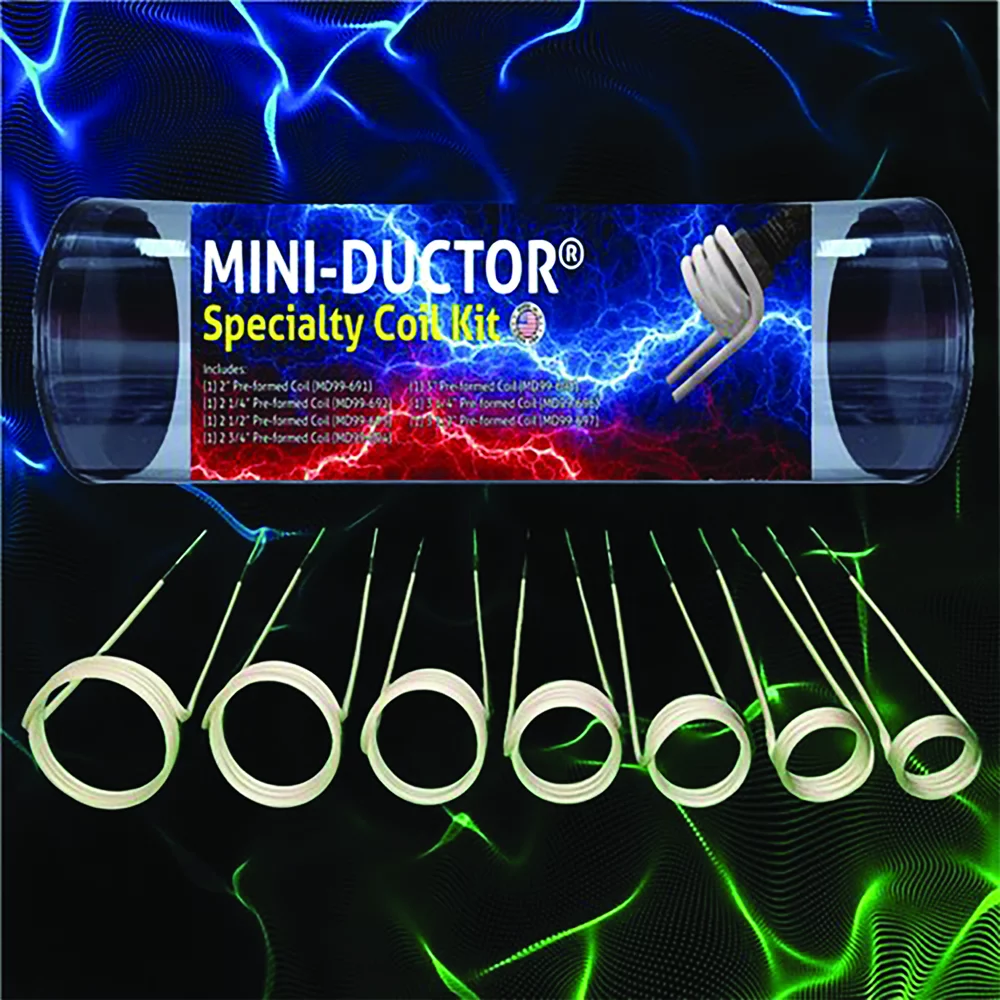
Specialty Coil Kt-Incl. 1ea MD99-691,MD99-692,MD99-693,MD99-694,
Mfg: Induction Innovations
Part #: MD99-690
FAQs
Will an induction heater always work on a badly rusted axle nut?
Not always. Low-wattage consumer units often lack the power to fully break down heavy corrosion. A mid-to-high wattage unit (roughly 2000+ watts) with a coil sized to the nut is generally needed to get consistent results on severely rusted hardware.
Is oxy-acetylene really better than a MAP-gas torch for this job?
For heavily corroded fasteners, yes. Oxy-acetylene reaches higher temperatures faster and burns through rust more effectively, and the same setup can switch to cutting if the nut needs to be removed rather than loosened.
Can I just use a bigger impact gun instead of heating the nut first?
You can try, but on a nut that’s rust-bonded rather than just torqued tight, more impact torque alone often just spins the socket or rounds the nut without breaking it free. Heat addresses the actual cause of the seizure.
Is it safe to cut the axle nut off with the CV joint still in place?
Yes, with care. Shield the CV boot and any nearby rubber or plastic components, and keep the cut focused on the nut itself rather than working close to the shaft or joint.
How do I know if the axle shaft is still reusable after a stuck nut?
Inspect the threads for damage from heat, cutting, or impact use. If threads are intact and clean up with a die, the shaft is typically fine to reuse. If the shaft was already being replaced (e.g., for a CV joint or hub failure), don’t spend extra time preserving it.
What’s the best way to prevent this from happening again?
Anti-seize compound on the threads at reassembly, combined with periodic inspection in high-salt climates, is the most effective preventive step. It won’t stop corrosion entirely but significantly reduces bonding at the threads.
Get the Right Sockets for Axle Nut Removal
Choosing the proper axle nut socket matters as much as your choice of heat source or impact gun. A quality six-point socket stands up to both the heating process and repeated impact use without rounding off the fastener.
- Six-point sockets designed to resist rounding on corroded fasteners
- Impact-rated options built for high-torque removal
- Complete size ranges to fit common and metric axle nuts

The Toolsource Technical Team blends decades of real-world automotive service experience with up-to-date technical research. Our writers collaborate with professional mechanics, shop owners, and diagnostic specialists to deliver practical, workshop-ready guidance you can trust.


Follow us on social media