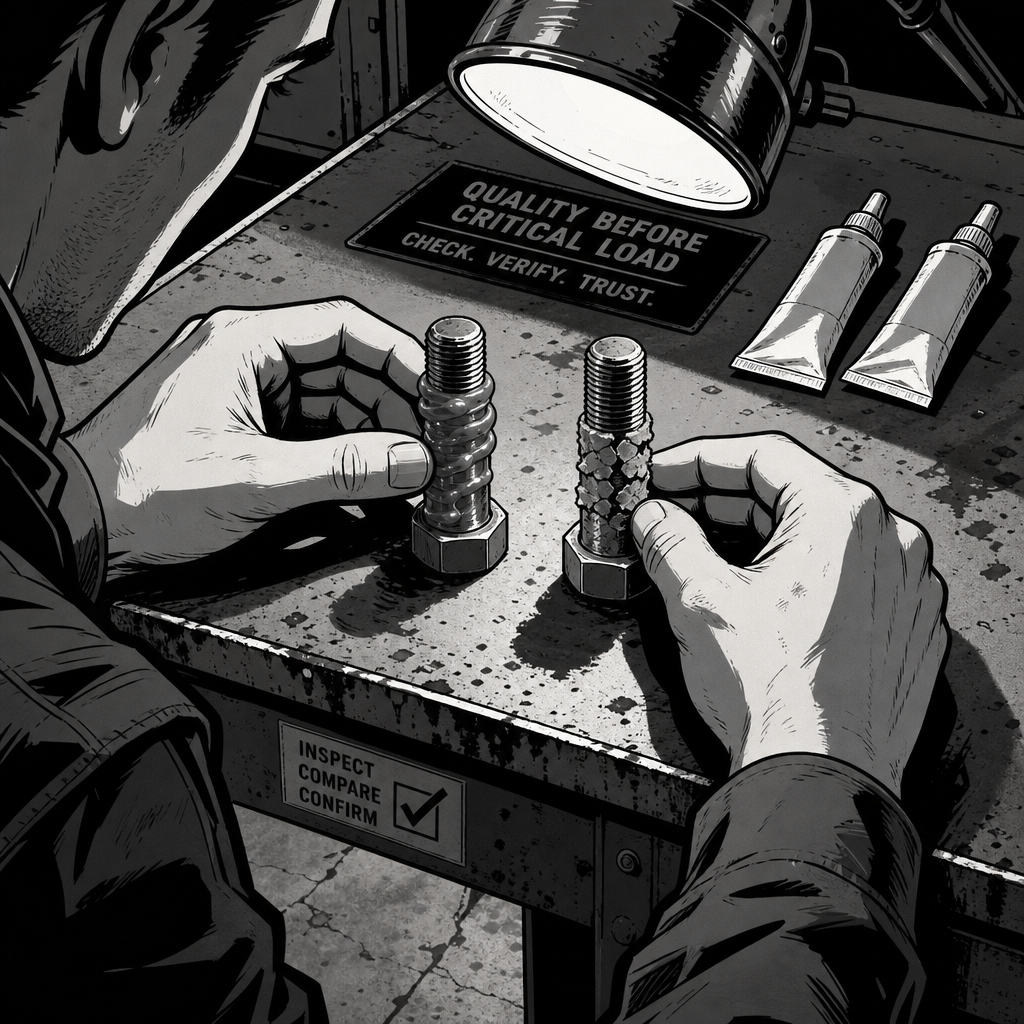
A growing number of technicians are noticing that threadlocker ordered online doesn’t behave like the bottle they’re used to from the parts counter. Bottles arrive with foreign-market labeling, the cured adhesive feels harder and more brittle than expected, and in some cases the product performs closer to a different color/strength than what’s printed on the label. None of this is paranoia — it’s a real supply chain problem, and it’s worth understanding before you rely on a thread-locking or sealing product for anything torque-critical.
Why Gray-Market and Reformulated Threadlocker Ends Up in Your Order
Loctite, Permatex, and similar manufacturers sell region-specific formulations to hit different price points and regulatory requirements. A tube marked for the Indian or Mexican market may be priced lower for that local economy, but it isn’t necessarily identical to the domestic-market version sold at a US auto parts counter. Regulations on VOCs and certain solvents vary by country, which can force a manufacturer to adjust the formulation slightly to stay compliant — sometimes with a real effect on cure hardness, flexibility, or working time.
The problem is that third-party marketplace sellers buy the cheaper regional product in bulk and resell it into markets where buyers expect the domestic version. You order what looks like standard blue 243 threadlocker, and what shows up has Hindi or Spanish text printed over the label, or packaging that doesn’t match what’s on the shelf at a bricks-and-mortar parts store. It’s not always a deliberate counterfeit — sometimes it’s legitimate product that’s simply been diverted from its intended market — but the performance difference is the same headache either way. There have also been long-standing reports of retailers relabeling recalled or discontinued cheap stock with new stickers, so a fresh-looking label isn’t proof of anything by itself.
How Anaerobic Threadlockers Actually Cure
Before troubleshooting a “bad” tube, make sure you understand the chemistry, because a misunderstanding here causes as many complaints as the counterfeit issue. Threadlocker is an anaerobic adhesive — it cures in the absence of oxygen, not the presence of it. That’s counterintuitive for anyone used to RTV silicone or contact adhesives that skin over in open air. Threadlocker will stay liquid indefinitely in an open bottle, but the instant it’s squeezed between two mating metal surfaces (which exclude air) and in contact with the metal ions that catalyze the reaction, it starts to cure.
This has two practical implications for techs:
- Never fill a bottle completely full when decanting or consolidating stock — trapped air with no headspace can encourage the product to skin or partially gel inside the container over time, effectively turning part of the bottle into waste.
- A bottle that seems “thick” or partially cured near the tip after storage isn’t automatically counterfeit — check the cap seal and expiration date first before assuming the product itself is fake.
ColorConnex Type C 1/4 Inch Body Plug Blue 1/4 Inch Female NPT 2
Mfg: Legacy Manufacturing
Part #: A72430C-2PK
Spotting Fake or Mismatched Product Before You Trust It on a Job
If you already have a tube on hand and want to check it, the most reliable test is a side-by-side comparison against a known-genuine sample from a domestic retail source. Apply both to a scrap bolt, let them cure the recommended time, then break them loose and compare:
- Cure texture — genuine domestic Loctite 243 (blue, medium strength) should cure to a semi-flexible, slightly rubbery bond that shears with hand tools. If your sample cures rock-hard and brittle, closer to what you’d expect from red (high-strength) product, that’s a red flag the formulation isn’t what the label claims.
- Color and viscosity — inconsistent color, unusual thickness, or a chemical smell that doesn’t match what you’re used to are worth noting.
- Packaging details — printing that looks off-register, overlaid text in another language, or a batch/lot code format that doesn’t match the manufacturer’s usual style.
- Seller history — third-party marketplace sellers with generic names and no brand authorization are higher risk than the brand’s official storefront or a listing fulfilled and sold directly by the retailer.
If a torque-critical joint depends on this bond — wheel hardware, suspension fasteners, anything on a lift point — it’s not worth gambling on a $6 savings from an unverified listing.
Where to Source Genuine Threadlocker and Flange Sealant
The most consistent way to avoid this problem is to buy from sources that stock the domestic formulation and have accountability if something’s wrong:
- Traditional auto parts retailers (NAPA, O’Reilly, AutoZone, Canadian Tire in Canada) generally carry the standard domestic lineup, though stock and pricing can vary by location — some techs report having to check a few stores to find larger sizes or the full red/blue/green lineup.
- Buying directly from the manufacturer’s site or an authorized industrial distributor removes the reseller-diversion risk entirely.
- On marketplaces, favor listings explicitly sold and shipped by the retailer or brand, not unnamed third-party sellers, and read recent reviews for complaints about mismatched packaging.
- For shop consumables you go through often, buying the larger bulk bottle from an industrial supplier is usually both cheaper per ounce and lower risk than small novelty-sized tubes from marketplace sellers.
Storage, Shelf Life, and Application Best Practices
Even genuine product degrades if it’s mishandled. A few points worth building into shop habits:
- Check the date code. Anaerobic adhesives have a real shelf life — commonly cited around one to two years unopened when stored correctly — and heat exposure accelerates degradation. A tube that’s been sitting in a hot delivery truck or a sun-baked storage bin is more likely to have thickened or partially cured before it ever reaches the shop.
- Store upright, capped tightly, away from direct heat and sunlight. Metal contamination from a dirty applicator tip can also trigger premature curing inside the bottle.
- Clean and degrease threads before application. Oil residue on threads is one of the most common causes of a “bad batch” complaint that’s actually a prep issue, not a product issue.
- Match strength to the joint. Blue (removable, medium strength) for fasteners you’ll service again; red (permanent, high strength) for fasteners that should not come apart without heat; don’t substitute one for the other based on what’s cheapest that week.
Flange Sealant and Anaerobic Gasket Makers Deserve the Same Scrutiny
The same gray-market and reformulation concerns apply to anaerobic flange sealants (like Loctite 518 or equivalent Permatex products), and the stakes are often higher because these seal fluid-carrying joints under load. There are documented cases of flange sealant failing within hours on a properly torqued, dead-flat machined joint — even when the surfaces and torque sequence were correct. When a sealed joint fails quickly on a surface you know is flat and clean, don’t assume operator error first; consider that the sealant itself may not have cured to spec, especially if it came from an unfamiliar supplier. Reapplying with a known-good tube from a verified source, on a joint that previously failed with unfamiliar product, is a reasonable diagnostic step before blaming the assembly work.
Quick Checklist Before You Trust a Threadlocker or Sealant Tube
- Confirm the listing is sold/shipped by the retailer or an authorized seller, not an unverified third party
- Check the date code and look for signs of heat damage or a partially cured tip
- Compare cure texture against a known-genuine sample if you have any doubt
- Match strength/color to the job — don’t improvise substitutions
- Degrease and clean threads or flange surfaces before application, regardless of product source
- Reserve torque-critical and pressure-sealing joints for verified, domestically sourced product only
FAQs
Is threadlocker sold on Amazon fake?
Not always — much of it is genuine product, but region-specific formulations meant for other markets can end up diverted into US listings by third-party sellers. It may be legitimate product that simply isn’t the domestic-spec version, which can still mean different cure performance.
How can I tell if my threadlocker cured correctly?
Genuine blue (medium-strength) threadlocker should cure to a semi-flexible bond that a hand tool can break loose without heat. If it cures rock-hard and brittle, or doesn’t cure at all after 24 hours, something is off with either the product or the application (contaminated threads, expired product, insufficient metal contact).
Does threadlocker cure with air exposure or without it?
Without it. Threadlocker is anaerobic — it stays liquid in the open bottle and only cures once squeezed between mating surfaces that block oxygen, activated by contact with metal ions.
How long does threadlocker last unopened?
Typically around one to two years from the manufacture date when stored upright, capped, and away from heat and direct sun. Always check the printed date code rather than assuming shelf life.
Is Permatex as reliable as Loctite for flange sealant?
Both brands have loyal users, but there are enough field reports of Permatex flange sealant underperforming on properly prepped, flat, torqued joints that some shops standardize on Loctite for critical sealing applications. If you’ve had a failure on a joint you know was done correctly, it’s worth trying a different verified-source product before reworking the assembly.
Where’s the safest place to buy genuine threadlocker?
Traditional auto parts retailers (NAPA, O’Reilly, AutoZone, Canadian Tire), the manufacturer’s official site, or listings explicitly sold and fulfilled by the retailer/brand rather than an unnamed third-party marketplace seller.
Shop Genuine Adhesives
Once you’ve verified your threadlocker source, keep your shop stocked with reliable anaerobic adhesives and sealants. Browse our Adhesives selection for trusted brands and formulations you can count on for torque-critical and pressure-sealing work.
- Threadlocker products (blue, red, green) for different fastener types and service scenarios
- Anaerobic flange sealants and gasket makers for sealed joints under load
- Genuine, verified products from established manufacturers

The Toolsource Technical Team blends decades of real-world automotive service experience with up-to-date technical research. Our writers collaborate with professional mechanics, shop owners, and diagnostic specialists to deliver practical, workshop-ready guidance you can trust.


Follow us on social media